Friday, June 21
I have been having so much trouble sleeping in! Today I woke up at 6:30, which was a massive improvement over yesterday’s 4:30. It’s not too easy getting back to sleep, either, particularly because our apartment (like the rest of Tokyo) can get quite humid.
Yesterday, having woken up at that ungodly hour and found myself unable to get back to sleep, I bought tickets for one of two teamLab installations in Tokyo. They’re a digital art/interactive art group that rents out gigantic warehouses for their projects. I chose Borderless after some online research, but they also have another exhibit called Planets elsewhere in the city (and several more worldwide).
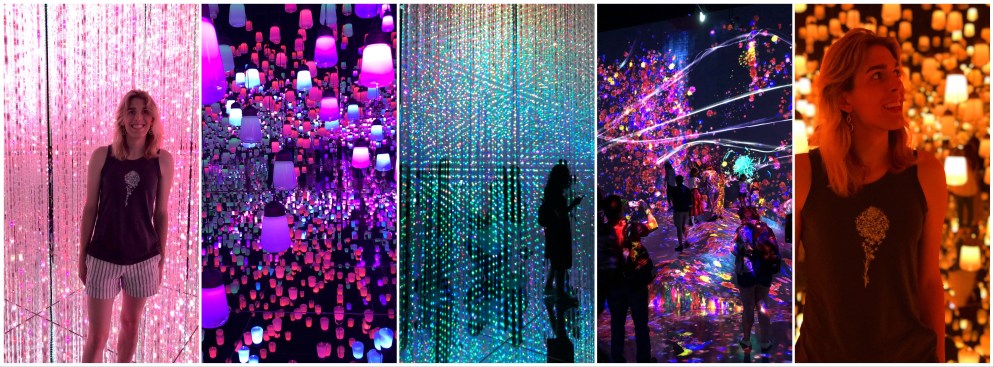
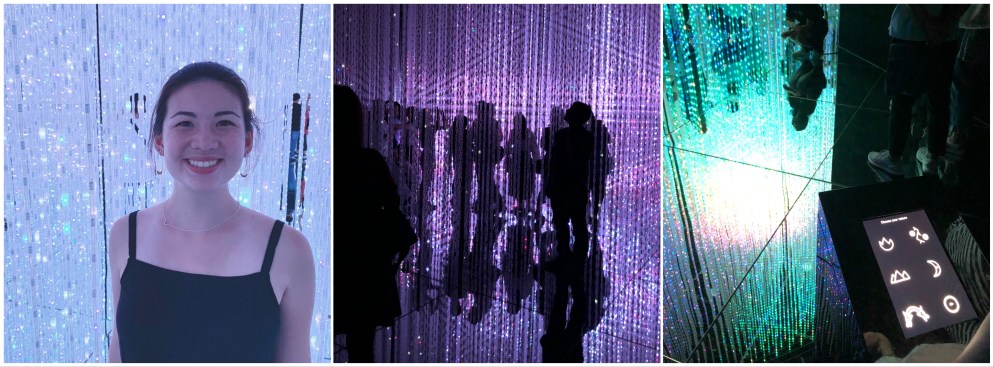
Here’s a preview!
Odaiba
teamLab: Borderless is located in Odaiba, which is this strange entertainment village on an artificial island in Tokyo Bay. There’s a science museum that emphasizes robots, themed malls (Venice?), a massive Ferris wheel, and even a “life-sized” Unicorn Gundam statue which we planning intending to seek out but couldn’t miss from the elevated train. It’s accessible via the Yurikamome light rail and also across something called the Rainbow Bridge (Mario Kart anyone?) which is supposedly a tourist attraction. We emerged in a shopping area called Palette Town (no relation to Pokémon’s Pallet Town, I’ve learned), grabbed some food at a Starbucks (familiar comfort), then walked around a massive warehouse to join hundreds of ticket-holders in line for Borderless. It was busy, but still kind of an off-putting place. I’m not really a theme park enthusiast.
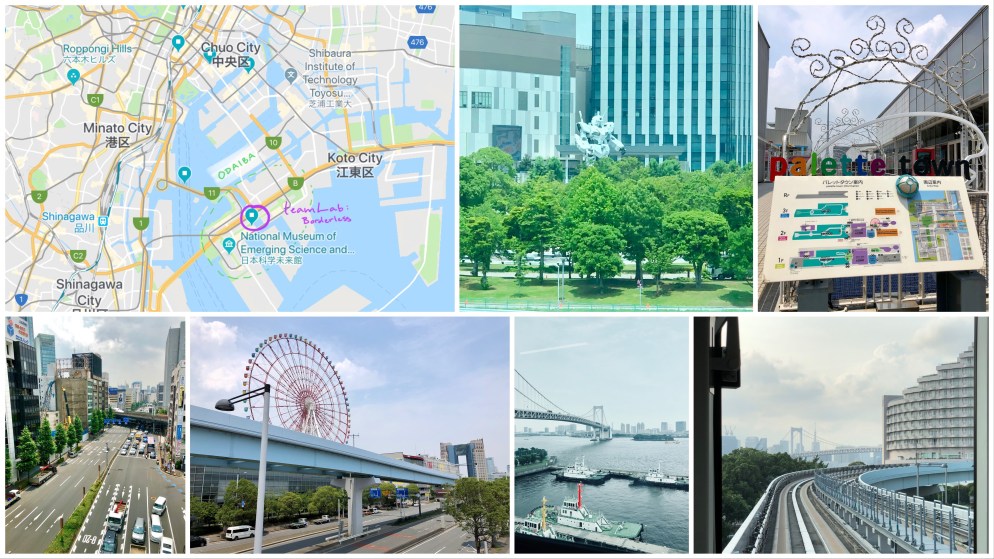
Odaiba from Shinjuku: Marunouchi Line toward Ikebukuro to Akasaka-Mitsuke Station (3 stops); Ginza Line toward Asakusa to Shimbashi Station (3 stops); walk across street to entrance to Yurikamome elevated train line toward Toyosu and take it 9 stops to Aomi Station. Around 40 minutes and a lovely view from Yurikamome. Also, the Yurikamome Shimbashi Station had the nicest restrooms I think I’ve ever seen.
teamLab: Borderless
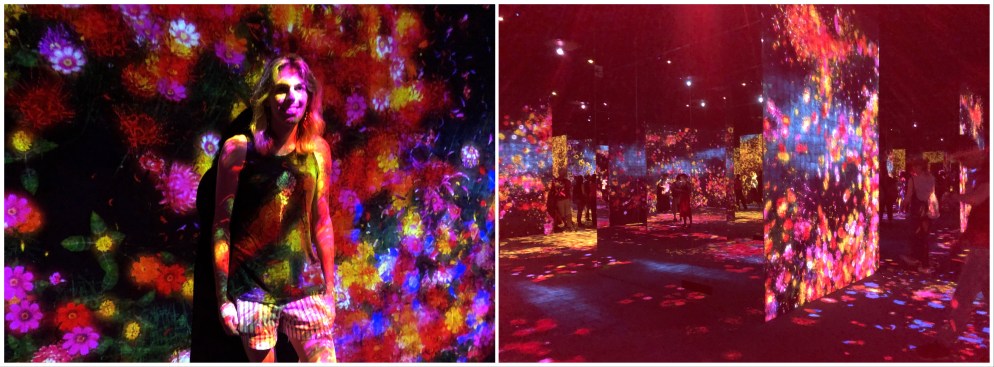
Borderless isn’t timed once you’re in it, but it is BUSY. The line to get in was at least 100 people long and took about a half an hour, and there were lines on the inside as well for select rooms. The layout is open (“borderless”) and consists of many dark rooms lit by projections on the walls which morph according to teamLab’s procedural algorithm and sometimes react to human activity. As advertised in a little pre-entrance video they showed us, some of the artworks move between rooms, and rooms gradually “evolve” so that if you return to them later they might not look the same. Borderless makes good use of mirrors and terrain (one of the big entrance rooms has a rock-like formation that sometimes looks like a waterfall when the projectors deem it appropriate), and many of the doorways between rooms are covered in curtains that make the projection across them look seamless and render the exits almost invisible.
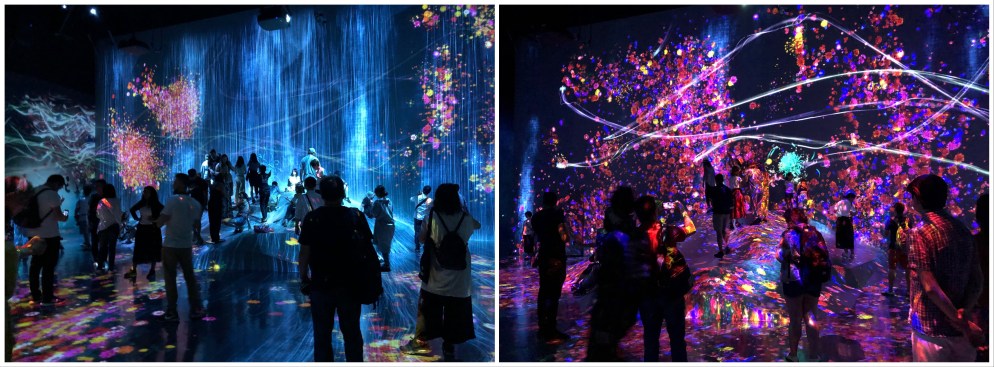
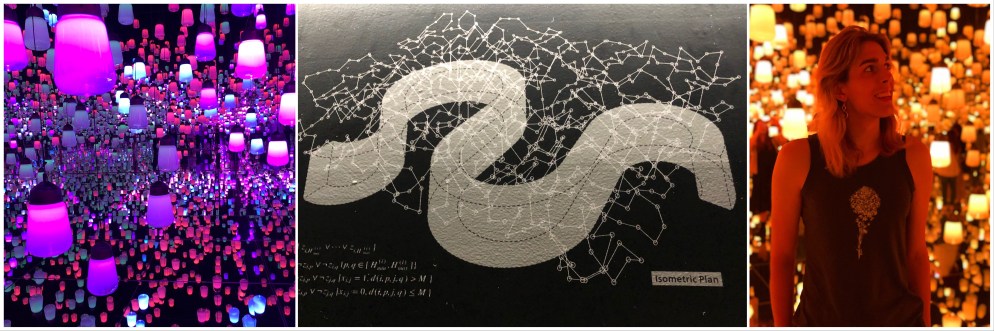
A few rooms are timed and involve special installations; these are normally the ones with carefully-managed lines. One of them was the Forest of Resonating Lamps, which houses a network of very beautiful interconnected lamps (information on the walls of the staircase up provided some of the mathematical equations that are supposed to govern the colors and intensities of the lamps depending on their neighbors), which actually worked well with the line because a one-way mirror allowed you to watch people moving through the lamps ahead of you (we enjoyed trying to identify patterns). The most popular room, the Floating Nest (you get to lay down in a suspended net and watch projections move around you), never had a line under an hour long, so we gave it a pass. Crystal World, on the other hand, we went into multiple times from different angles, in spite of the fact that it’s probably the most Instagrammable place in Borderless. We even found a corner nook that felt like a cave under a waterfall which we hadn’t noticed the first time: it contained a console that directly altered the pattern of the hanging “crystal” lights (there is also a phone app that can do the same thing, but it felt much more immediate using the console).
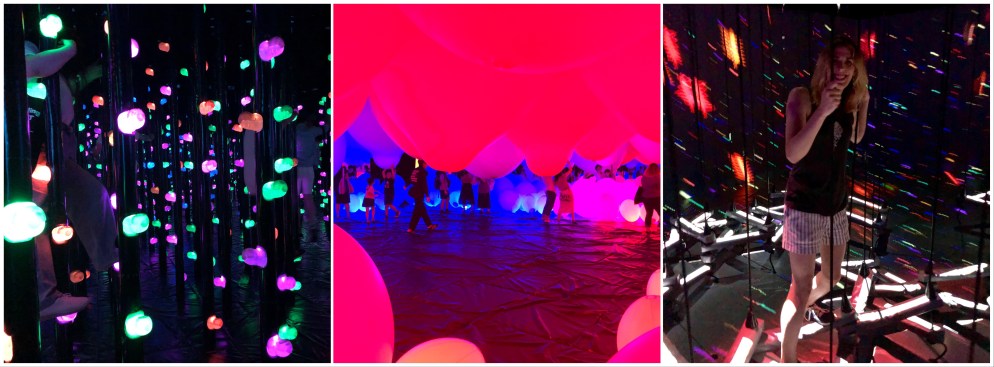
There were also a couple of different “worlds” that offered specific kinds of interactive exhibits: Athletic Forest included more interesting topography and active experiences, like this trampoline thing and a massive balloon lamp area. We climbed through the Light Forest Three-Dimensional Bouldering area, in which you were supposed to climb through what felt like a bamboo grove with foot- and hand-holds, and the exhibit responded to you limiting your route to one color (this was actually more difficult than I expected, and the things actually went pretty high!). We also briefly went through this very jiggly “Aerial Climbing Through a Flock of Colored Birds” zone made up of interconnected suspended wooden segments. We passed up the En Tea House, where you can purchase tea that blossoms (via projection) when left alone, and scatters its blossoms dramatically to start anew whenever you take a sip. (Our main reason was that we’d forgotten to bring money with us from the bag lockers, but also it was cool enough to just watch the tea-drinkers intently leaning over their teacups from behind black curtains.)
The whole experience was very cool, and we spent about three hours completely lost in the “borderless” world. Definitely worth seeing, but…
My biggest gripe with Borderless was that it didn’t really feel interactive. A lot of the animations were neat and sometimes very believable (e.g., thunderstorms and trippy spinning space animations), but felt like they were just moving around on a loop, or randomly. The hallways often had these processions of people or musicians or rabbits moving around, but I don’t think their loops were dependent on the guests or on the states of the rooms they moved through. (Supposedly, they would acknowledge you if you touched them, but I tried this with some of the hallway artworks and didn’t see any changes.) The Crystal World definitely did respond to user input, but it was a very simple one-to-one “element” request and corresponding light pattern. We noticed a pattern in the Resonating Lamps in which they went mostly orange for a while, then went pink and blue for a while (trans pride colors!), then back to orange… and everyone in line seemed to be hoping that their timed entry would coincide with the pink and blue phase. Shouldn’t it have been a bit more diverse than that? Supposedly the lights responded to people moving through them and communicated with each other, but we couldn’t really see this happening.
One of the installations that most highlighted the failure of the interactivity goal was the Light Sculpture room, which we entered as it was resetting. Basically, it was a lightshow set to incredibly dramatic music—every time the music reached a crescendo, the tune would restart in an even higher and more frantic key. Everyone was standing around the edges of the room watching the lights move predictably in the center, and it wasn’t until after we left the room that we saw a poorly lit sign indicating that the lights reacted to people interrupting their beams—no wonder it was so boring! The room wasn’t designed in a way that made this obvious, though, and I can only imagine that fifty people standing in the middle of the light beams would just cause chaos instead of fun interactions.
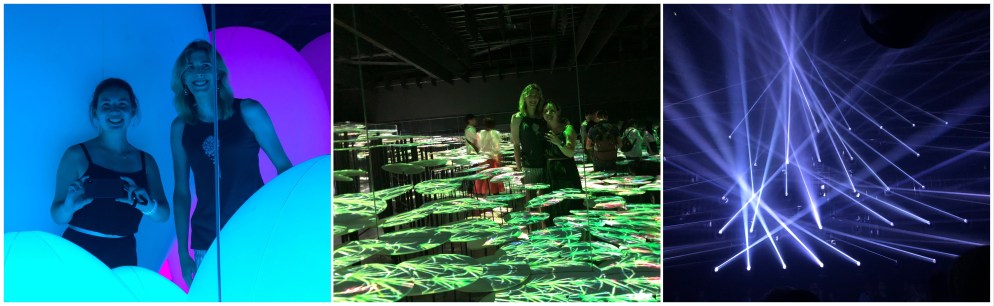
That leads me to my second gripe: there were too many people! I understand that teamLab has no incentive to lower the maximum daily capacity of their exhibitions, and I appreciated being able to get tickets the day before, but I think the experience would have been much nicer (and perhaps actually interactive at times) if the number of people had been cut in half and the interior lines abolished. I don’t think art should feel frantic and packed. But it was a part of this experience, and it was still very enjoyable overall.
Sushi Stop
Before heading into Akihabara, we wanted to grab dinner at a place Jane had scoped out online as being cheap-but-tasty conveyor-belt sushi. When we arrived at Kanda Edokko Sushi (just south across the bridge from Akihabara), however, it turned out the place wasn’t some tourist-friendly conveyor belt deal. It was packed with Japanese businessmen and there was nary an English sign to be found. (It’s not uncommon for us to have to match Google/TripAdvisor photos of a restaurant’s storefront to actual signs on the street because there isn’t prominent English, but this just felt even less tourist-friendly.) We were about to turn around and find somewhere else to go when a woman who was cleaning the step of the neighboring restaurant told us in broken English that they were having a weekend deal, and she pointed toward a small flyer with very decent numbers next to pictures of delicious sushi. Sold!
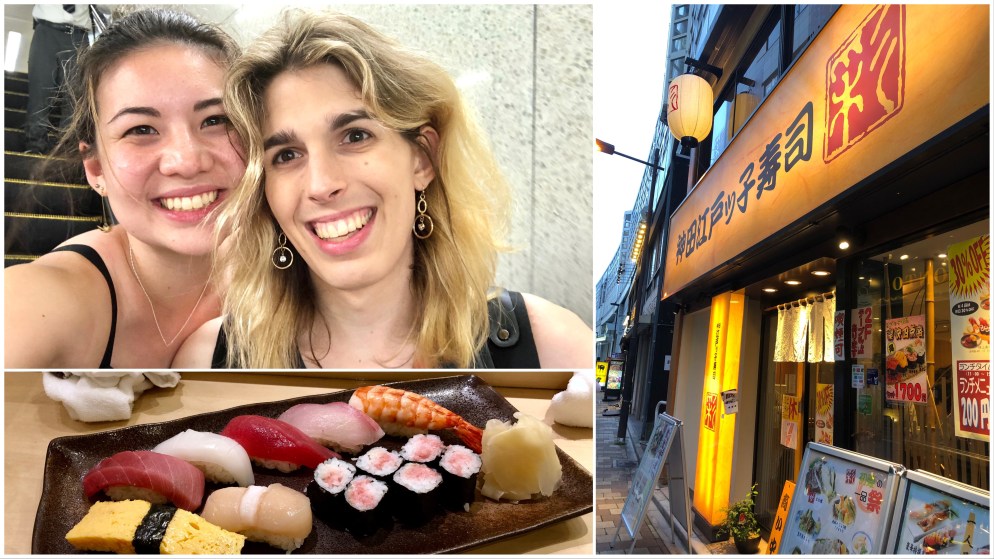
We were the only non-Japanese people in the restaurant for the entire meal. It was a little nerve-wracking at first, because we felt sweaty, underdressed, and conspicuously foreign, but that’s what traveling is all about! This place was bar seating only, surrounding the two sushi chefs. The men around us were loud drinkers and seemed to be regulars. We were glad we’d been practicing our basic Japanese survival phrases at every store and restaurant:
- Sumimasen! (Sorry/Excuse me)
- Hai, onegaishimasu (Yes, please)
- Arigato gozaimasu (Thank you)
- Watashi wa biru o tsusukidesu. (I would like one beer please.)
Akihabara
It sounds like Akihabara used to be THE place in Tokyo to get cheap electronics. It continues to house gigantic many-floor (sometimes up to 10) electronics giants on every corner, but it is now also the place to go for most Japanese “culture” nerds (is “weeaboos” offensive? I genuinely don’t know). By “culture” I do mean culture, just not poetry, stationary, kimono, etc: more like anime, manga, and J-pop girl groups. Maid cafes are also a thing in Akihabara. You evidently go in and the waitresses are dressed like maids. The cafes and their street advertisers are everywhere.
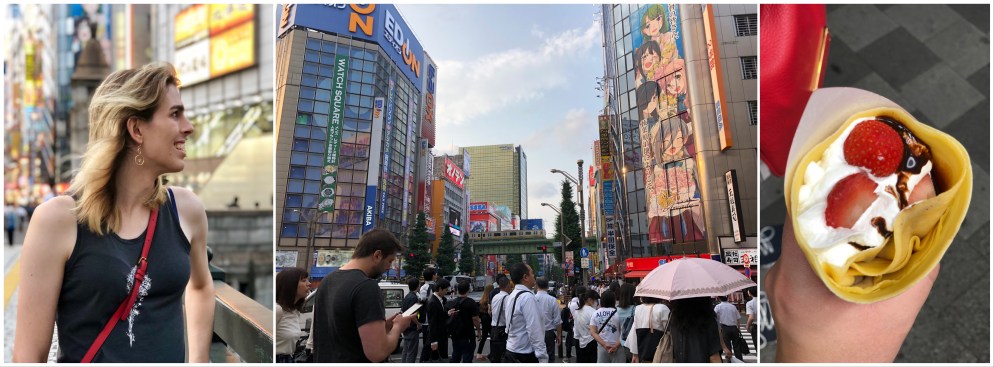
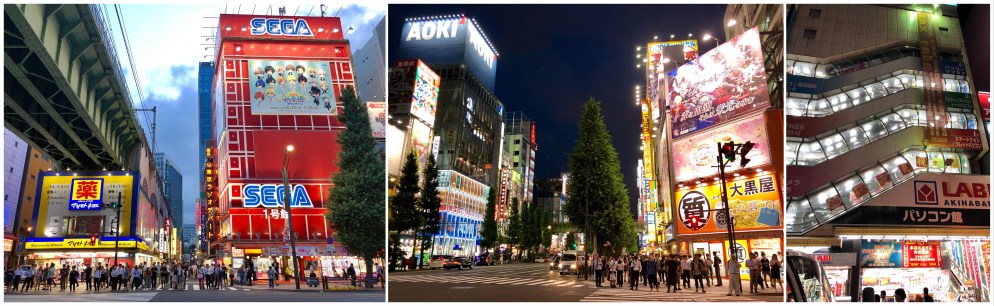
It seemed like the right move to be there in the evening, because it was teeming with people. The massive video advertisements and neon lights made it feel like a strange perversion of Times Square. We wandered up and down the corridor eating crepes and checking out stores (although whenever we ate we actually ate in place, because it’s rude to walk and eat in Japan), including two enormously diverse and well-stocked sex shops right across the street from each other, four and six floors respectively. Nowhere in America could you find something like that…
 The Wild Blue Yonder
Beautiful pics!
LikeLike