Saturday, June 22
We spent the morning deliberating between train and bus travel to the Kansai region (Osaka, Nara, Kyoto). Seriously, it was two grueling hours of research and cost comparisons, conducted on one iPad and a phone. In the end, we booked tickets on a Willer overnight bus—details to come in a future post!
Himawari Sushi Shintoshin: sushi-go-round #1
Having whiled away our breakfast hour, we wandered out into Shinjuku to investigate a tempura place Jane had found online. As often happens, it seems, the place turned out to be much more expensive and legit-looking than it seemed online ($30 for an entree? It’s tempura!), so we kept going to a conveyor belt sushi place Jane had also bookmarked.
We’d been to conveyor belt sushi before, and it’s kind of a fun concept: in a “traditional” place, the sushi chefs are in the middle of a rectangular bar that also has a conveyor belt going around, and they place individual nigiri on color-coded plates and then onto the conveyor belt as they make it. You can grab anything that passes you by and your final tab is calculated by the combination of empty plates you’ve stacked in front of you. In a larger-scale conveyor belt sushi operation, the sushi chefs are hidden away in a kitchen and the conveyor belt originates there before winding up and down rows of booths.
This one was the rectangular bar setup, with two chefs in the middle. We’ve noticed that oftentimes in Japan when food is served at a bar (which it very often is) the bar had little spigots at every place setting so that you can self-pour hot water for your matcha tea. Other things are often self-serve too, like water pitchers at regular intervals and, at sushi restaurants, things like ginger and sometimes wasabi. I love the unlimited, interaction-free tea refills!
The one downside of this sushi-go-round was that most of the people there seemed to be Japanese (perhaps not regulars; tourists and families?), and this meant they felt confident ordering all of their sushi specially from the chef. This seems like a common practice if you want something you don’t see going around, but we were there to have a quiet, minimal-interaction lunch and actually pull nigiri off of the belt, and this meant that the chefs had very little time to produce standard-issue nigiri! The stuff we had was still good (not nearly as good as Kanda Edokko though), but we spent an awful long time waiting for things we wanted to see to come by. Much tea was had. Also, the one other non-Japanese group in the restaurant was this extremely loud couple of British girls whose laughs were way too big for that tiny place. (Was I just in a bad mood?)
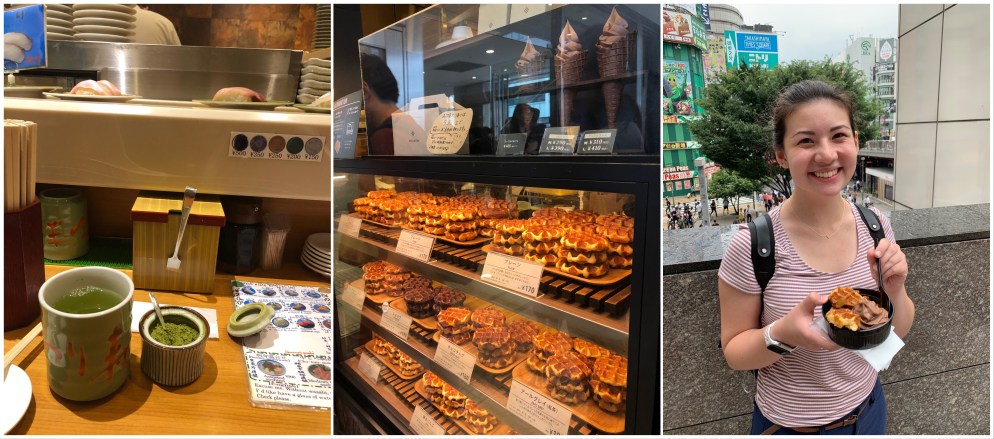
After lunch, we had our first run-in with one of the famed Japanese department stores (Lumine 2 in Shinjuku station, which probably isn’t nearly as big as the really famous ones), which we almost couldn’t find our way out of. Our reward was a Belgian waffle and dark chocolate ice cream stand at the entrance (Mr. Waffle)—always a winner. For the first time, we talked to a tourist information desk about our upcoming travel and learned that we could get to Nikko entirely on local trains that took our SUICA transport cards. It would be about a 3-hour ride north, with a transfer at Utsonomiya, for about $25 each.
Shinjuku and its largest denizen, Gojira
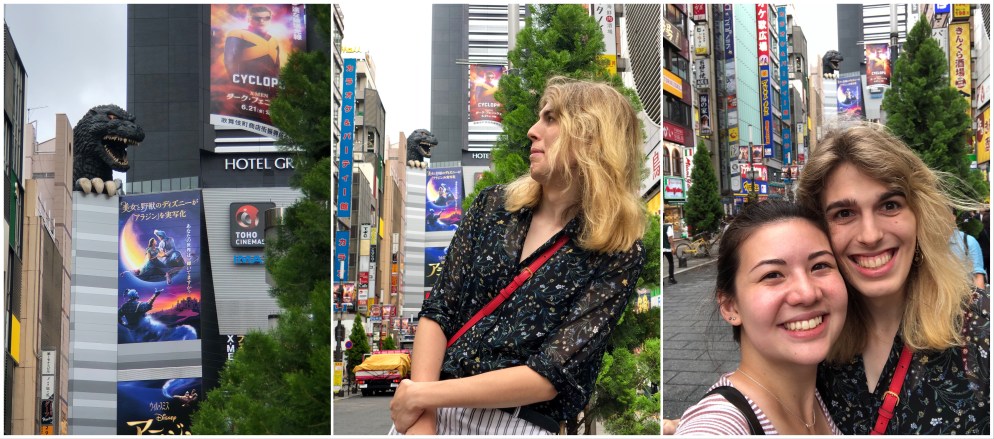
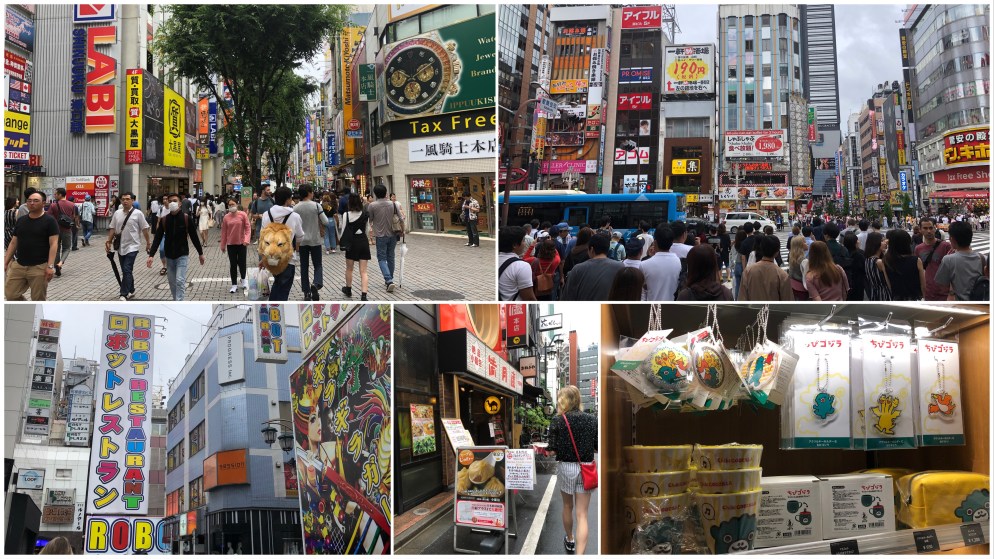
Shinjuku is one of those neighborhoods that Japan tour books like to recommend for general exploration, and it makes sense to me! We’ve been loving our time in different parts of Shinjuku and we enjoyed strolling about in this particular hot-zone (east of Shinjuku Station). Our main highlight here was the giant Godzilla (gojira!) head on the 8th floor of Hotel Gracery (I briefly tried but was unable to get a hotel room with an across-the-street view of this monstrosity), which looms large and goofy over the street. We also went up into the adjoined Toho cinema (which is the company that originally produced Godzilla, Jane informed me) and thought about getting tickets for the recent Hollywood film Godzilla: King of the Monsters, but found that none of the times worked for us. We’d originally been up there to find the Godzilla head, but it turns out it’s only accessible through the hotel, and it sounded like only guests there were supposed to use the private elevator. One reviewer on Google said he enjoyed the 8th-floor attraction but mentioned that he probably shouldn’t have just “gaijin-smashed” his way up there, which is our new favorite hybrid phrase.
Shinjuku is also known for having tons of restaurants and nice stores, and is home to a few other gimmicky places like more animal cafes (indeed) and the Robot Restaurant, which is a popular tourist attraction that we weren’t too interested in. I think it’s pretty self-explanatory (except there’s also a robot show during the meal?).
We also stopped into a four-story MUJI store and ended up spending over $100 there (which made it tax-free, with our passports!). Ugh, don’t ask me about the MUJI things. My mom and I have this love affair with MUJI (and places like it); I exclusively use their pens and bizarre little bags and containers now. Now that we’re finally in Japan, MUJI is everywhere, and it’s beautiful! (Sadly, though, they were out of the little cylindrical fold-up scissors that I didn’t bring on this trip because I was afraid of airport confiscation.)
Another theater nearby was showing Godzilla with Japanese subs at a more convenient hour, so we grabbed some tickets. To kill time, we stopped into Cat Cafe Mocha, which I’ll describe in a little more detail later (link to come). Suffice to say that more so than the Shiba cafe and definitely in contrast to the owl cafe, Cat Cafe Mocha is an institution. It was massive and extremely aesthetically consistent and, we learned, there are locations across Tokyo and in a few other big Japanese cities as well. It’s also one of those pay-by-the-10-minutes places, which makes cat enjoyment a little frantic, but we managed to get around that in a later visit. Afterwards, we found the cheapest and easiest dinner nearby, which happened to be “carbonara” at an “Italian” cafe chain called Segafredo. Cannot recommend, but it was an experience to have fast foreign food in Japan.
Because I’m not a critic, I can say that Godzilla: King of the Monsters was awesome. Jane is a moderate fan of Japanese kaiju films (she particularly likes Mothra, who made an appearance), but my only other exposure is seeing the original Godzilla film at a screening at the Silver Spring AFI as a child (which I enjoyed). It might be obvious from the title/trailer but you’re rooting for Godzilla in this movie, and that makes everything better. I was far less invested in the Millie Bobby Brown character/family plotline—actually, all of the humans, except for Dr. Serizawa (Ken Watanabe), who is a huge Godzilla fanboy and enjoyably interjected “But what about… Godzilla!?” into every conversation. Tywin Lannister was also in this movie.
(Also, we are now fans of Japanese movie theaters! Both of the ones we saw had little gift shops with merchandise related to the films it was showing, which is capitalist but convenient, and the theater provided optional blankets!)
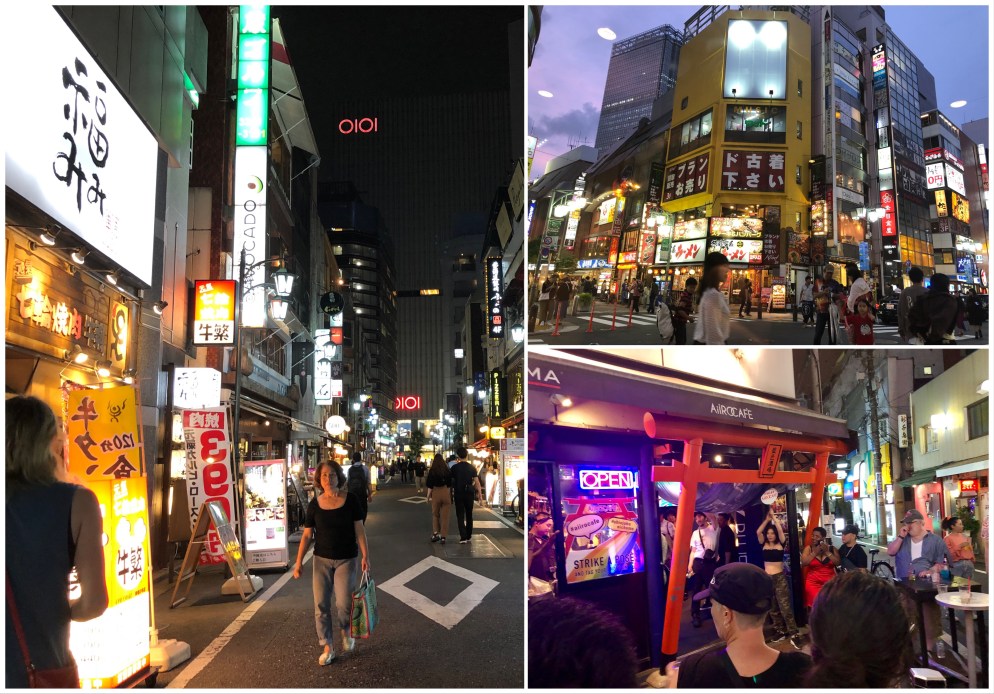
Queer Shinjuku
This was our last night at our lovely little apartment in Shinjuku, so we wanted to go out and enjoy the bar scene (the nearby Golden Gai is this area full of tiny bars with 4-8 seats each, which is cool; and also there are tons of gay and lesbian bars that we’d scoped out during the day and evening but didn’t have the confidence to enter), but we were so pooped. We were on the fence about whether or not we had the energy to go out safely. Then, on the way back to our apartment, we passed by these two already-drunk young Japanese guys in suits who asked us, almost comically, “Drinku?”, and when we shook our heads sadly and said “We have to go put down our stuff…” they widened their eyes in horror and gasped “NO DRINKU???”
This sounds like a horrible mock stereotype or something but that’s exactly what they did and how they pronounced it (possibly for our benefit), and it probably pushed us over the edge. So we dropped off our stuff, changed, and wandered back across the street to all of the lovely queer bars we’d seen when passing through. We stopped at the first one (Aiiro Cafe) that was overflowing and seemed to have a mix of genders and it turned into a lovely night that included multiple bars, an impromptu drag show with cartwheels and death drops (it was the queen’s birthday evidently), a barfight, some extremely nice British uni students, and a surprisingly delicious last drink of the night which I think was a spicy ginger Moscow mule.
 The Wild Blue Yonder