Day 4 (Tokyo): Day Shinjuku and Night Shinjuku (and Godzilla)

Saturday, June 22

We spent the morning deliberating between train and bus travel to the Kansai region (Osaka, Nara, Kyoto). Seriously, it was two grueling hours of research and cost comparisons, conducted on one iPad and a phone. In the end, we booked tickets on a Willer overnight bus—details to come in a future post!

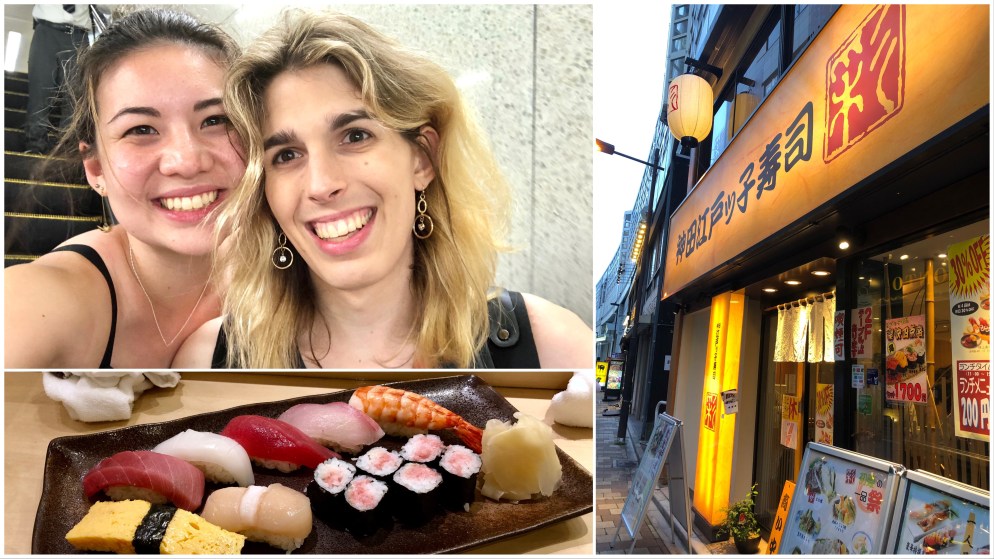
Himawari Sushi Shintoshin: sushi-go-round #1

Having whiled away our breakfast hour, we wandered out into Shinjuku to investigate a tempura place Jane had found online. As often happens, it seems, the place turned out to be much more expensive and legit-looking than it seemed online ($30 for an entree? It’s tempura!), so we kept going to a conveyor belt sushi place Jane had also bookmarked.

We’d been to conveyor belt sushi before, and it’s kind of a fun concept: in a “traditional” place, the sushi chefs are in the middle of a rectangular bar that also has a conveyor belt going around, and they place individual nigiri on color-coded plates and then onto the conveyor belt as they make it. You can grab anything that passes you by and your final tab is calculated by the combination of empty plates you’ve stacked in front of you. In a larger-scale conveyor belt sushi operation, the sushi chefs are hidden away in a kitchen and the conveyor belt originates there before winding up and down rows of booths.

This one was the rectangular bar setup, with two chefs in the middle. We’ve noticed that oftentimes in Japan when food is served at a bar (which it very often is) the bar had little spigots at every place setting so that you can self-pour hot water for your matcha tea. Other things are often self-serve too, like water pitchers at regular intervals and, at sushi restaurants, things like ginger and sometimes wasabi. I love the unlimited, interaction-free tea refills!

The one downside of this sushi-go-round was that most of the people there seemed to be Japanese (perhaps not regulars; tourists and families?), and this meant they felt confident ordering all of their sushi specially from the chef. This seems like a common practice if you want something you don’t see going around, but we were there to have a quiet, minimal-interaction lunch and actually pull nigiri off of the belt, and this meant that the chefs had very little time to produce standard-issue nigiri! The stuff we had was still good (not nearly as good as Kanda Edokko though), but we spent an awful long time waiting for things we wanted to see to come by. Much tea was had. Also, the one other non-Japanese group in the restaurant was this extremely loud couple of British girls whose laughs were way too big for that tiny place. (Was I just in a bad mood?)
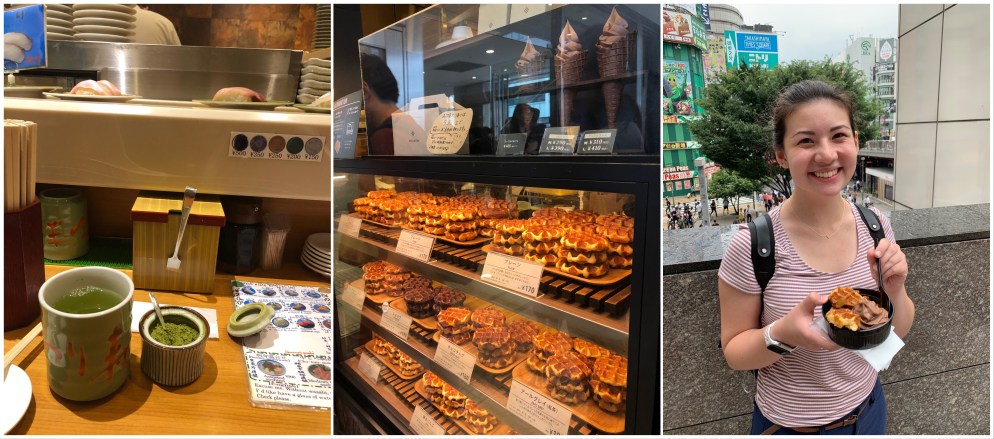
I am like a wrinkly baby. But in all seriousness, it was a delicious morning!

After lunch, we had our first run-in with one of the famed Japanese department stores (Lumine 2 in Shinjuku station, which probably isn’t nearly as big as the really famous ones), which we almost couldn’t find our way out of. Our reward was a Belgian waffle and dark chocolate ice cream stand at the entrance (Mr. Waffle)—always a winner. For the first time, we talked to a tourist information desk about our upcoming travel and learned that we could get to Nikko entirely on local trains that took our SUICA transport cards. It would be about a 3-hour ride north, with a transfer at Utsonomiya, for about $25 each.

Shinjuku and its largest denizen, Gojira
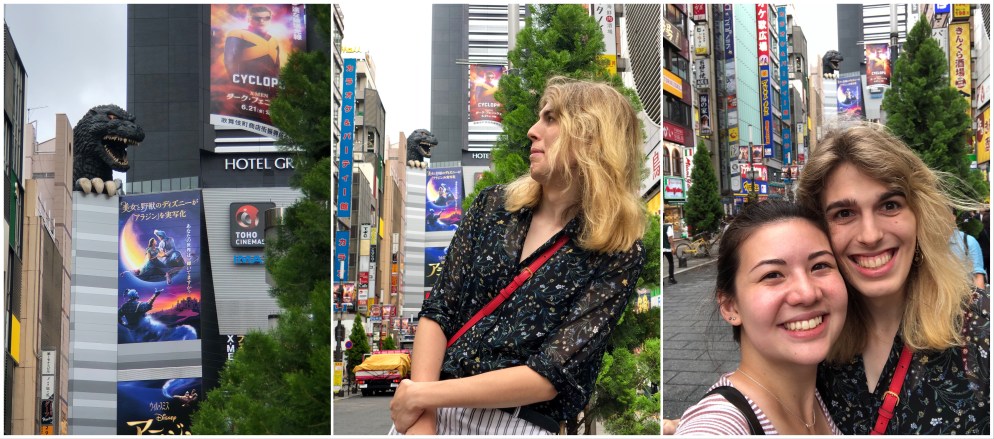
O-oh no! There goes Tokyo, go go Godzilla! 🎶

Shinjuku is one of those neighborhoods that Japan tour books like to recommend for general exploration, and it makes sense to me! We’ve been loving our time in different parts of Shinjuku and we enjoyed strolling about in this particular hot-zone (east of Shinjuku Station). Our main highlight here was the giant Godzilla (gojira!) head on the 8th floor of Hotel Gracery (I briefly tried but was unable to get a hotel room with an across-the-street view of this monstrosity), which looms large and goofy over the street. We also went up into the adjoined Toho cinema (which is the company that originally produced Godzilla, Jane informed me) and thought about getting tickets for the recent Hollywood film Godzilla: King of the Monsters, but found that none of the times worked for us. We’d originally been up there to find the Godzilla head, but it turns out it’s only accessible through the hotel, and it sounded like only guests there were supposed to use the private elevator. One reviewer on Google said he enjoyed the 8th-floor attraction but mentioned that he probably shouldn’t have just “gaijin-smashed” his way up there, which is our new favorite hybrid phrase.

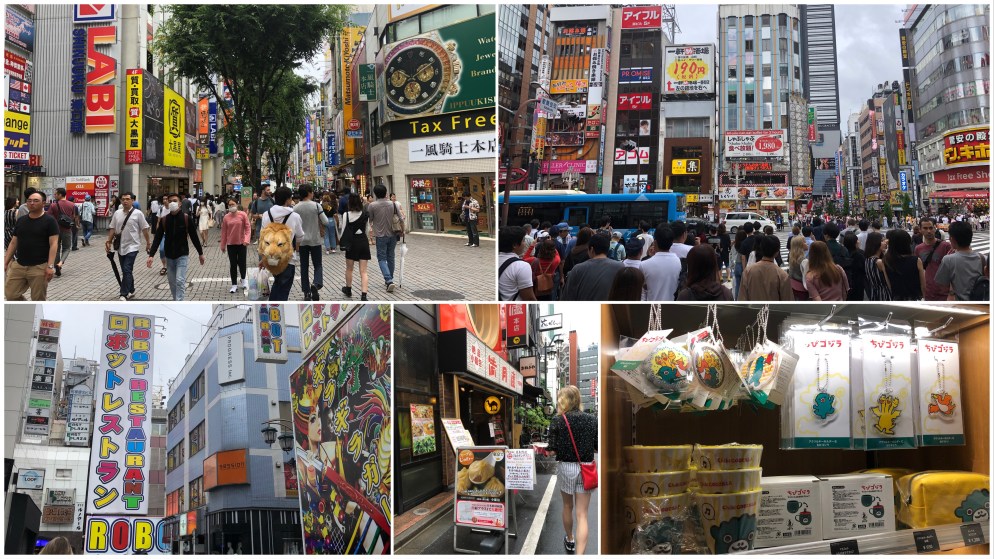
Shinjuku is also known for having tons of restaurants and nice stores, and is home to a few other gimmicky places like more animal cafes (indeed) and the Robot Restaurant, which is a popular tourist attraction that we weren’t too interested in. I think it’s pretty self-explanatory (except there’s also a robot show during the meal?).

We also stopped into a four-story MUJI store and ended up spending over $100 there (which made it tax-free, with our passports!). Ugh, don’t ask me about the MUJI things. My mom and I have this love affair with MUJI (and places like it); I exclusively use their pens and bizarre little bags and containers now. Now that we’re finally in Japan, MUJI is everywhere, and it’s beautiful! (Sadly, though, they were out of the little cylindrical fold-up scissors that I didn’t bring on this trip because I was afraid of airport confiscation.)

Another theater nearby was showing Godzilla with Japanese subs at a more convenient hour, so we grabbed some tickets. To kill time, we stopped into Cat Cafe Mocha, which I’ll describe in a little more detail later (link to come). Suffice to say that more so than the Shiba cafe and definitely in contrast to the owl cafe, Cat Cafe Mocha is an institution. It was massive and extremely aesthetically consistent and, we learned, there are locations across Tokyo and in a few other big Japanese cities as well. It’s also one of those pay-by-the-10-minutes places, which makes cat enjoyment a little frantic, but we managed to get around that in a later visit. Afterwards, we found the cheapest and easiest dinner nearby, which happened to be “carbonara” at an “Italian” cafe chain called Segafredo. Cannot recommend, but it was an experience to have fast foreign food in Japan.

Because I’m not a critic, I can say that Godzilla: King of the Monsters was awesome. Jane is a moderate fan of Japanese kaiju films (she particularly likes Mothra, who made an appearance), but my only other exposure is seeing the original Godzilla film at a screening at the Silver Spring AFI as a child (which I enjoyed). It might be obvious from the title/trailer but you’re rooting for Godzilla in this movie, and that makes everything better. I was far less invested in the Millie Bobby Brown character/family plotline—actually, all of the humans, except for Dr. Serizawa (Ken Watanabe), who is a huge Godzilla fanboy and enjoyably interjected “But what about… Godzilla!?” into every conversation. Tywin Lannister was also in this movie.

(Also, we are now fans of Japanese movie theaters! Both of the ones we saw had little gift shops with merchandise related to the films it was showing, which is capitalist but convenient, and the theater provided optional blankets!)
Queer Shinjuku

This was our last night at our lovely little apartment in Shinjuku, so we wanted to go out and enjoy the bar scene (the nearby Golden Gai is this area full of tiny bars with 4-8 seats each, which is cool; and also there are tons of gay and lesbian bars that we’d scoped out during the day and evening but didn’t have the confidence to enter), but we were so pooped. We were on the fence about whether or not we had the energy to go out safely. Then, on the way back to our apartment, we passed by these two already-drunk young Japanese guys in suits who asked us, almost comically, “Drinku?”, and when we shook our heads sadly and said “We have to go put down our stuff…” they widened their eyes in horror and gasped “NO DRINKU???”

This sounds like a horrible mock stereotype or something but that’s exactly what they did and how they pronounced it (possibly for our benefit), and it probably pushed us over the edge. So we dropped off our stuff, changed, and wandered back across the street to all of the lovely queer bars we’d seen when passing through. We stopped at the first one (Aiiro Cafe) that was overflowing and seemed to have a mix of genders and it turned into a lovely night that included multiple bars, an impromptu drag show with cartwheels and death drops (it was the queen’s birthday evidently), a barfight, some extremely nice British uni students, and a surprisingly delicious last drink of the night which I think was a spicy ginger Moscow mule.
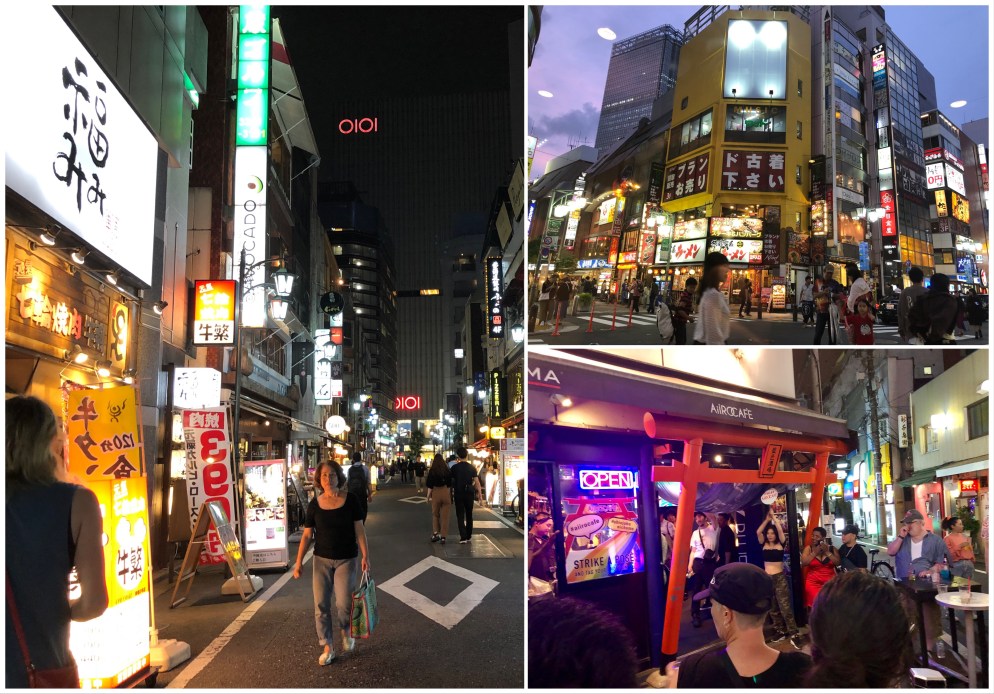
That bottom right image is the only photo I have from the night because we didn’t really take our phones out

Day 3 (Tokyo): Borderless and Akihabara

Friday, June 21

I have been having so much trouble sleeping in! Today I woke up at 6:30, which was a massive improvement over yesterday’s 4:30. It’s not too easy getting back to sleep, either, particularly because our apartment (like the rest of Tokyo) can get quite humid.

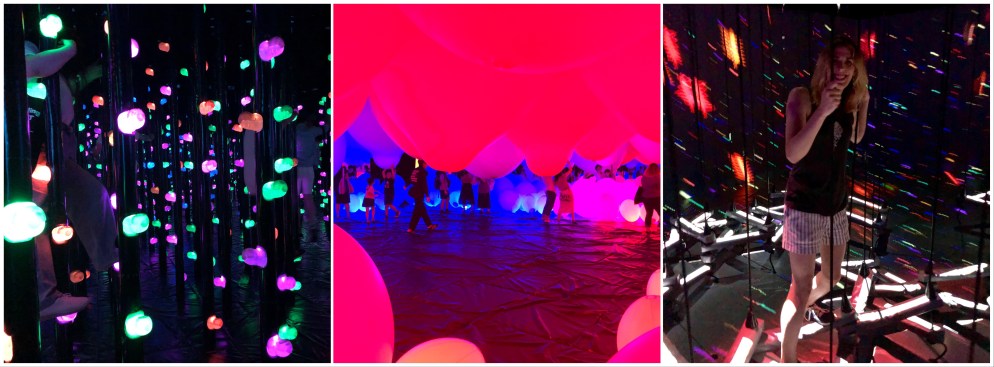
Yesterday, having woken up at that ungodly hour and found myself unable to get back to sleep, I bought tickets for one of two teamLab installations in Tokyo. They’re a digital art/interactive art group that rents out gigantic warehouses for their projects. I chose Borderless after some online research, but they also have another exhibit called Planets elsewhere in the city (and several more worldwide).

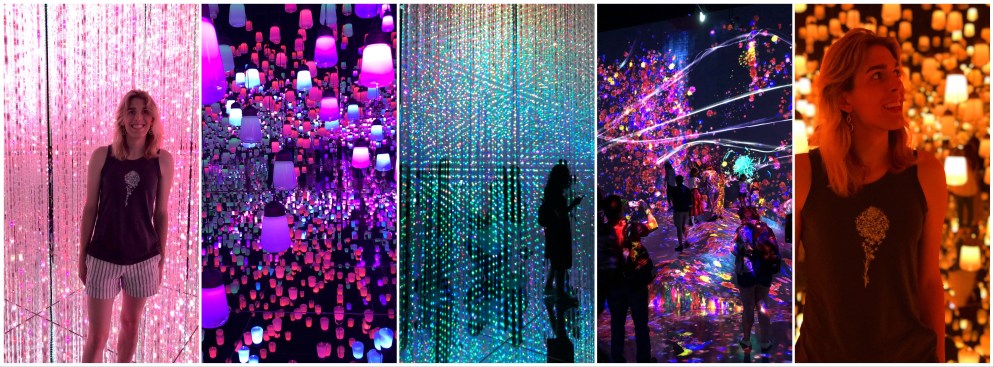
Here’s a preview!

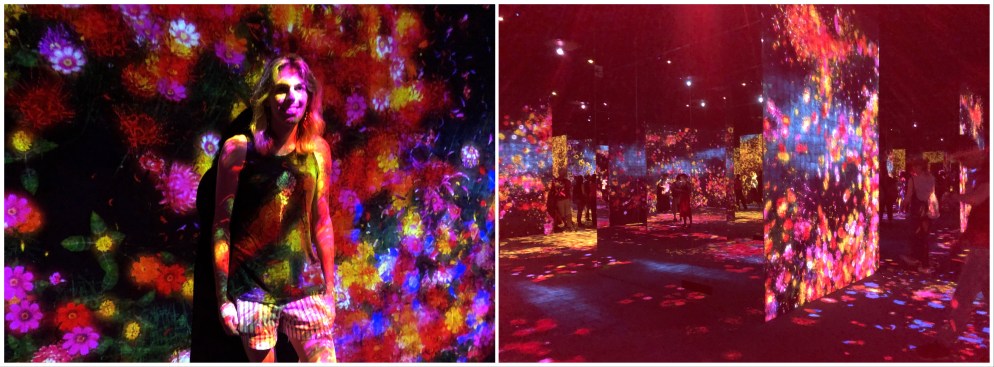
Artworks in teamLab: Borderless, featuring my wonderful girlfriend

Odaiba

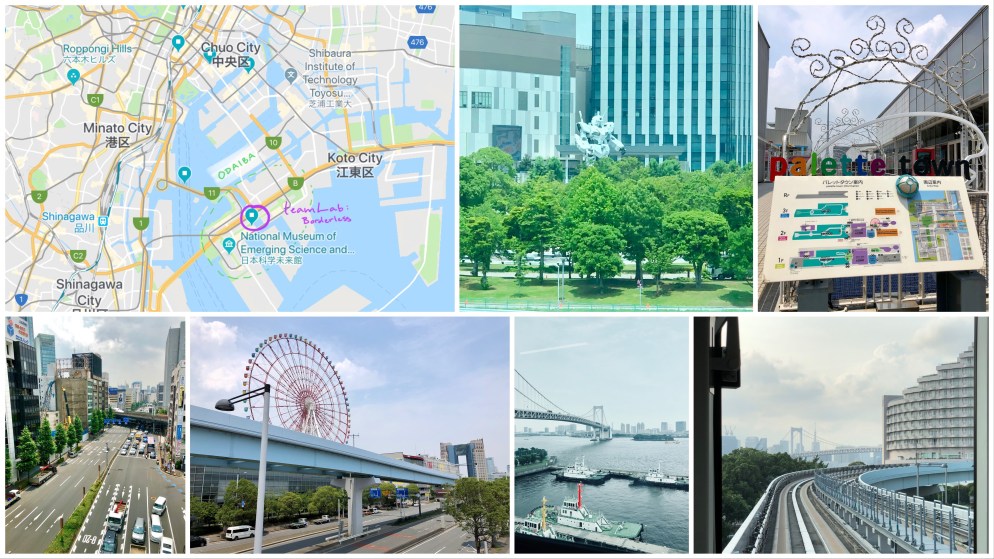
teamLab: Borderless is located in Odaiba, which is this strange entertainment village on an artificial island in Tokyo Bay. There’s a science museum that emphasizes robots, themed malls (Venice?), a massive Ferris wheel, and even a “life-sized” Unicorn Gundam statue which we planning intending to seek out but couldn’t miss from the elevated train. It’s accessible via the Yurikamome light rail and also across something called the Rainbow Bridge (Mario Kart anyone?) which is supposedly a tourist attraction. We emerged in a shopping area called Palette Town (no relation to Pokémon’s Pallet Town, I’ve learned), grabbed some food at a Starbucks (familiar comfort), then walked around a massive warehouse to join hundreds of ticket-holders in line for Borderless. It was busy, but still kind of an off-putting place. I’m not really a theme park enthusiast.

Top row: Odaiba relative to Tokyo; the Unicorn Gundam; entrance to Palette Town. Bottom row: views from the Yurikamome Line.

Odaiba from Shinjuku: Marunouchi Line toward Ikebukuro to Akasaka-Mitsuke Station (3 stops); Ginza Line toward Asakusa to Shimbashi Station (3 stops); walk across street to entrance to Yurikamome elevated train line toward Toyosu and take it 9 stops to Aomi Station. Around 40 minutes and a lovely view from Yurikamome. Also, the Yurikamome Shimbashi Station had the nicest restrooms I think I’ve ever seen.

teamLab: Borderless

Jane in the Borderless entrance room, which is full of mirrors and pulsating blossoms

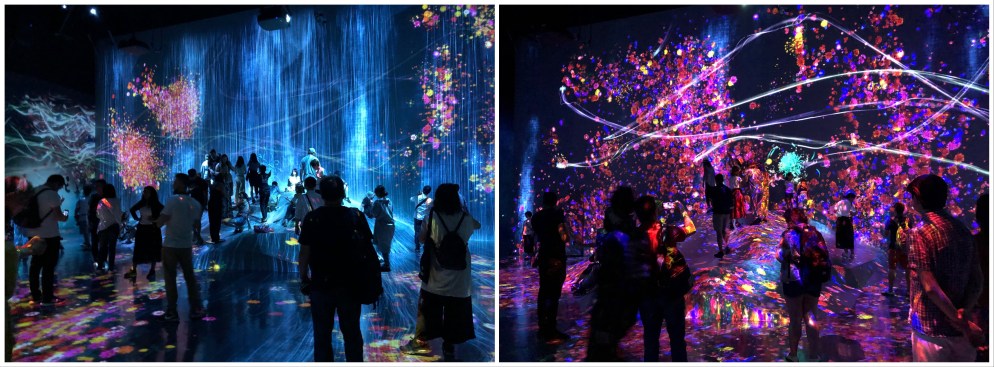
Borderless isn’t timed once you’re in it, but it is BUSY. The line to get in was at least 100 people long and took about a half an hour, and there were lines on the inside as well for select rooms. The layout is open (“borderless”) and consists of many dark rooms lit by projections on the walls which morph according to teamLab’s procedural algorithm and sometimes react to human activity. As advertised in a little pre-entrance video they showed us, some of the artworks move between rooms, and rooms gradually “evolve” so that if you return to them later they might not look the same. Borderless makes good use of mirrors and terrain (one of the big entrance rooms has a rock-like formation that sometimes looks like a waterfall when the projectors deem it appropriate), and many of the doorways between rooms are covered in curtains that make the projection across them look seamless and render the exits almost invisible.

Views of one of the central pieces in Borderless at different times

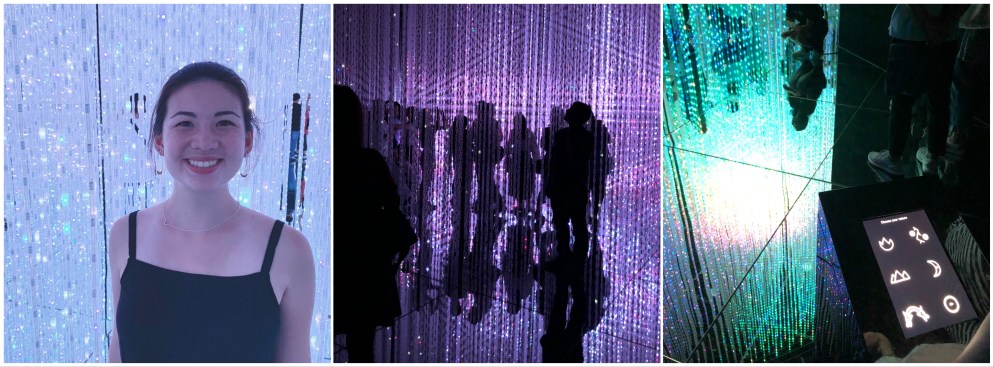
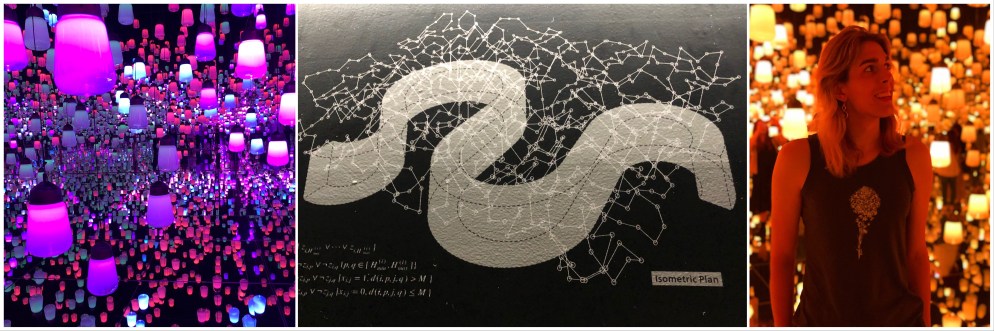
A few rooms are timed and involve special installations; these are normally the ones with carefully-managed lines. One of them was the Forest of Resonating Lamps, which houses a network of very beautiful interconnected lamps (information on the walls of the staircase up provided some of the mathematical equations that are supposed to govern the colors and intensities of the lamps depending on their neighbors), which actually worked well with the line because a one-way mirror allowed you to watch people moving through the lamps ahead of you (we enjoyed trying to identify patterns). The most popular room, the Floating Nest (you get to lay down in a suspended net and watch projections move around you), never had a line under an hour long, so we gave it a pass. Crystal World, on the other hand, we went into multiple times from different angles, in spite of the fact that it’s probably the most Instagrammable place in Borderless. We even found a corner nook that felt like a cave under a waterfall which we hadn’t noticed the first time: it contained a console that directly altered the pattern of the hanging “crystal” lights (there is also a phone app that can do the same thing, but it felt much more immediate using the console).

Me in Crystal World (which exists in almost all of the different teamLab exhibitions); the view from behind the “waterfall curtain” we found; the console that affected the pattern of the crystal lights

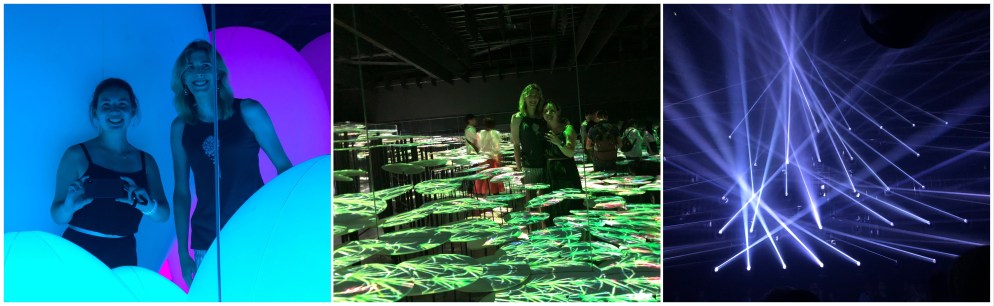
There were also a couple of different “worlds” that offered specific kinds of interactive exhibits: Athletic Forest included more interesting topography and active experiences, like this trampoline thing and a massive balloon lamp area. We climbed through the Light Forest Three-Dimensional Bouldering area, in which you were supposed to climb through what felt like a bamboo grove with foot- and hand-holds, and the exhibit responded to you limiting your route to one color (this was actually more difficult than I expected, and the things actually went pretty high!). We also briefly went through this very jiggly “Aerial Climbing Through a Flock of Colored Birds” zone made up of interconnected suspended wooden segments. We passed up the En Tea House, where you can purchase tea that blossoms (via projection) when left alone, and scatters its blossoms dramatically to start anew whenever you take a sip. (Our main reason was that we’d forgotten to bring money with us from the bag lockers, but also it was cool enough to just watch the tea-drinkers intently leaning over their teacups from behind black curtains.)

Three-Dimensional Bouldering; Weightless Forest of Resonating Life; Aerial Climbing

The whole experience was very cool, and we spent about three hours completely lost in the “borderless” world. Definitely worth seeing, but…

My biggest gripe with Borderless was that it didn’t really feel interactive. A lot of the animations were neat and sometimes very believable (e.g., thunderstorms and trippy spinning space animations), but felt like they were just moving around on a loop, or randomly. The hallways often had these processions of people or musicians or rabbits moving around, but I don’t think their loops were dependent on the guests or on the states of the rooms they moved through. (Supposedly, they would acknowledge you if you touched them, but I tried this with some of the hallway artworks and didn’t see any changes.) The Crystal World definitely did respond to user input, but it was a very simple one-to-one “element” request and corresponding light pattern. We noticed a pattern in the Resonating Lamps in which they went mostly orange for a while, then went pink and blue for a while (trans pride colors!), then back to orange… and everyone in line seemed to be hoping that their timed entry would coincide with the pink and blue phase. Shouldn’t it have been a bit more diverse than that? Supposedly the lights responded to people moving through them and communicated with each other, but we couldn’t really see this happening.

The Forest of Resonating Lamps, including some of the graphics meant to explain their algorithm

One of the installations that most highlighted the failure of the interactivity goal was the Light Sculpture room, which we entered as it was resetting. Basically, it was a lightshow set to incredibly dramatic music—every time the music reached a crescendo, the tune would restart in an even higher and more frantic key. Everyone was standing around the edges of the room watching the lights move predictably in the center, and it wasn’t until after we left the room that we saw a poorly lit sign indicating that the lights reacted to people interrupting their beams—no wonder it was so boring! The room wasn’t designed in a way that made this obvious, though, and I can only imagine that fifty people standing in the middle of the light beams would just cause chaos instead of fun interactions.

Weightless Forest of Resonating Life; Memory of Topography (lilypad field); Light Vortex

That leads me to my second gripe: there were too many people! I understand that teamLab has no incentive to lower the maximum daily capacity of their exhibitions, and I appreciated being able to get tickets the day before, but I think the experience would have been much nicer (and perhaps actually interactive at times) if the number of people had been cut in half and the interior lines abolished. I don’t think art should feel frantic and packed. But it was a part of this experience, and it was still very enjoyable overall.

Sushi Stop

Before heading into Akihabara, we wanted to grab dinner at a place Jane had scoped out online as being cheap-but-tasty conveyor-belt sushi. When we arrived at Kanda Edokko Sushi (just south across the bridge from Akihabara), however, it turned out the place wasn’t some tourist-friendly conveyor belt deal. It was packed with Japanese businessmen and there was nary an English sign to be found. (It’s not uncommon for us to have to match Google/TripAdvisor photos of a restaurant’s storefront to actual signs on the street because there isn’t prominent English, but this just felt even less tourist-friendly.) We were about to turn around and find somewhere else to go when a woman who was cleaning the step of the neighboring restaurant told us in broken English that they were having a weekend deal, and she pointed toward a small flyer with very decent numbers next to pictures of delicious sushi. Sold!

Me n’ Jane after having delicious sushi at Kanda Edokko

We were the only non-Japanese people in the restaurant for the entire meal. It was a little nerve-wracking at first, because we felt sweaty, underdressed, and conspicuously foreign, but that’s what traveling is all about! This place was bar seating only, surrounding the two sushi chefs. The men around us were loud drinkers and seemed to be regulars. We were glad we’d been practicing our basic Japanese survival phrases at every store and restaurant:

  • Sumimasen! (Sorry/Excuse me)
  • Hai, onegaishimasu (Yes, please)
  • Arigato gozaimasu (Thank you)
  • And, for this occasion, because I wanted to blend in with the businessmen:
    • Watashi wa biru o tsusukidesu. (I would like one beer please.)
  • I think I tried to specify Sapporo to be extra clear because it was what came to mind, but they served Asahi. Kirin and Sapporo are the only things I’ve seen make it to the States. I have no opinion on Japanese beers so far—they’re fine.
  • Akihabara

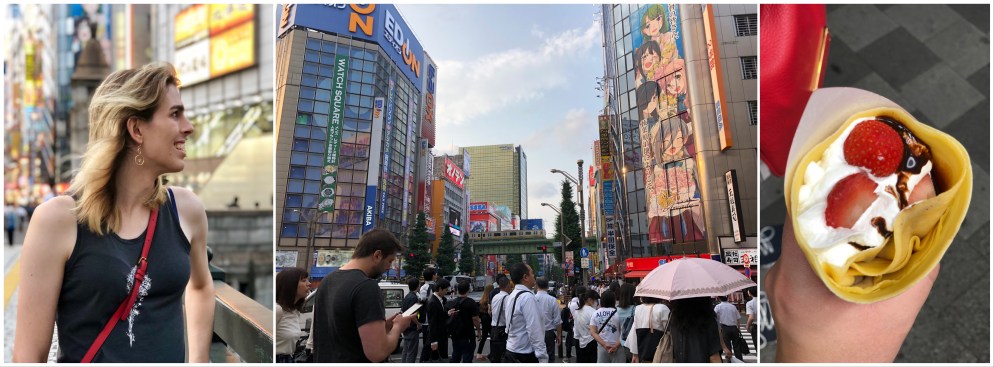
    It sounds like Akihabara used to be THE place in Tokyo to get cheap electronics. It continues to house gigantic many-floor (sometimes up to 10) electronics giants on every corner, but it is now also the place to go for most Japanese “culture” nerds (is “weeaboos” offensive? I genuinely don’t know). By “culture” I do mean culture, just not poetry, stationary, kimono, etc: more like anime, manga, and J-pop girl groups. Maid cafes are also a thing in Akihabara. You evidently go in and the waitresses are dressed like maids. The cafes and their street advertisers are everywhere.

    Jane on the bridge south of Akihabara’s main center on Chuo Dori; Chuo Dori; soothing evening crepes

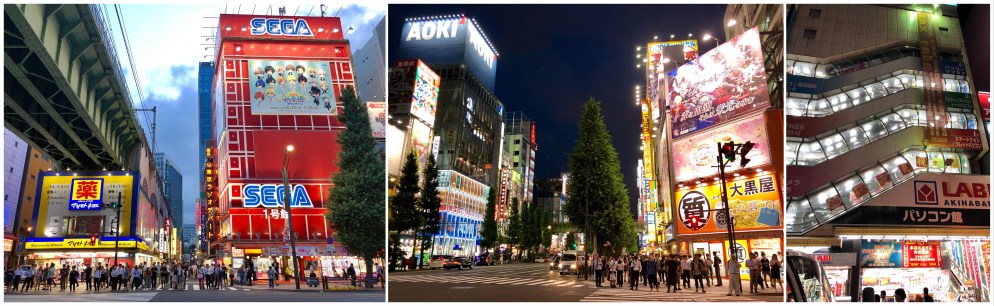
    It seemed like the right move to be there in the evening, because it was teeming with people. The massive video advertisements and neon lights made it feel like a strange perversion of Times Square. We wandered up and down the corridor eating crepes and checking out stores (although whenever we ate we actually ate in place, because it’s rude to walk and eat in Japan), including two enormously diverse and well-stocked sex shops right across the street from each other, four and six floors respectively. Nowhere in America could you find something like that…

    Akihabara at night. Don’t the escalator cutouts look like hamster tubes?

    Day 2 (Tokyo): Harajuku and Shibuya

    Thursday, June 20

    Today, we decided to stay close to home; that is, within a few metro stops of our Airbnb. Tokyo is huge, so this means that we hardly even moved relative to the Imperial Palace and the rest of the city.

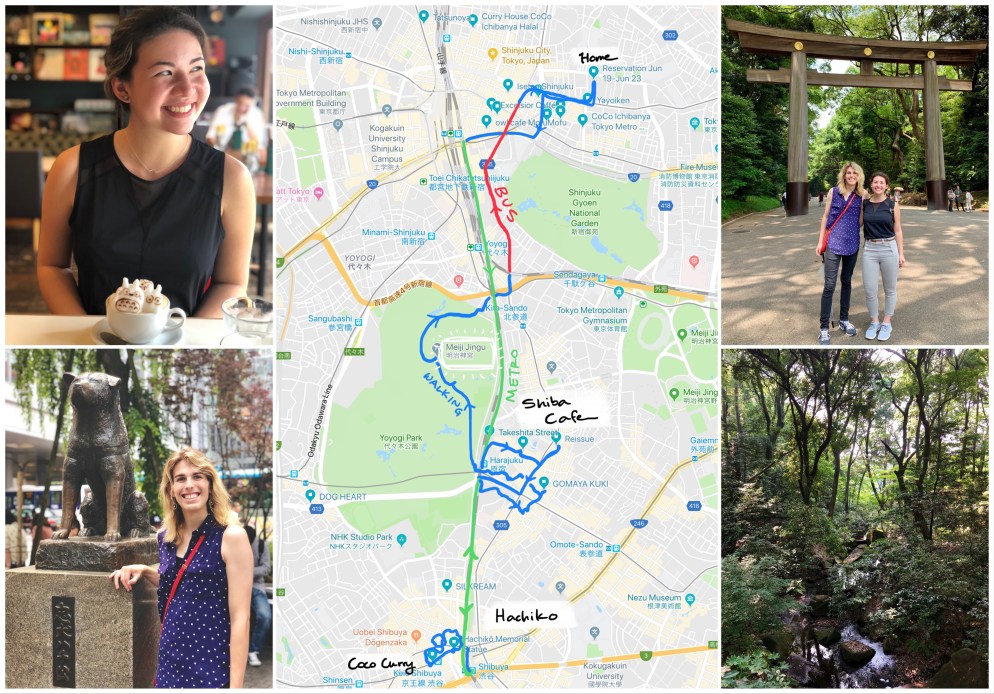
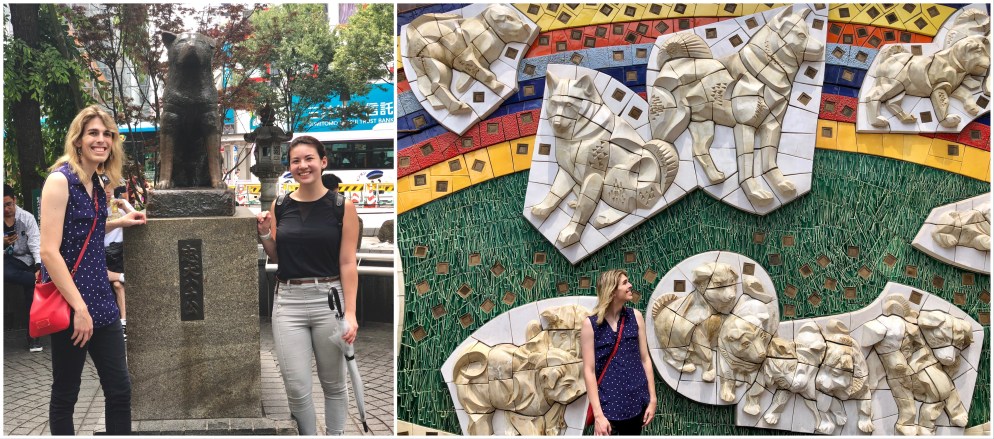
    UL: latte art at Reissue; BL: Jane at the Hachikō Memorial Statue. M: our route from Shinjuku. UR: one of the entrance torii in Yoyogi Park. BR: nature in Yoyogi.

    We started with the Shiba cafe we’d been eyeing (see other post). Huge success. The cafe was on the third floor of a building on Takeshita Dori (street), which certain travel sites claim is full of “many trendy shops, fashion boutiques, used clothes stores,” etc. To us, it just looked like a touristy street full of overpriced, incredibly low-quality clothing and souvenirs, but we aren’t really fashion shoppers so maybe we overlooked some hidden gems. We were there for the shibas, anyway.

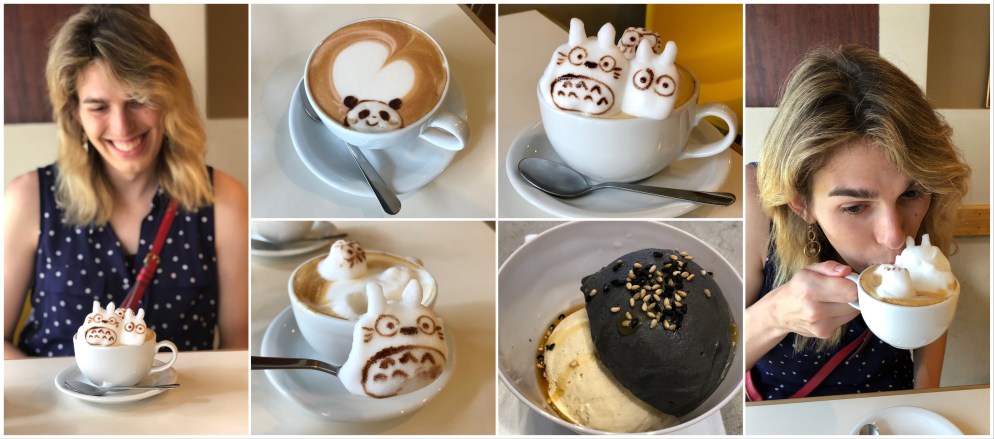
    Reissue Latte Art and Black Sesame Ice Cream

    I’d compiled a list of little places to stop by if we were ever in the area, like cafes, small museums, and restaurants. (It’s really hard to get a sense of geography until you’re in the city itself!) After the shiba-bonanza, we wandered over to Reissue Cafe, which specializes in cute latte art. The place required that all patrons order at least one drink (hence the little panda), but everything was decently priced given that it caters to tourists. We felt so bad eating the Totoro. Later in the day, we looped back to Gomaya Kuki, which specializes in sesame ice cream. The scoops pictured below are “rich black” and “rich white” (they also offer “triple rich” of each). I kid you not that this is now my all-time favorite ice cream.

    Latte art at Reissue Cafe in Harajuku; also, delicious black sesame ice cream from Gomaya Kuki

    Hachikō 😥

    It was around 75ºF and very humid, so we took the metro (instead of walking the very walkable walk) one stop down to Shibuya, where the Hachikō Memorial statue watches over the station. I haven’t seen the Japanese movie or the Richard Gere adaptation because I just never feel like spending an evening bawling, but the gist is that there was this dog who loved his human and would meet him every day at Shibuya Station after work. When the dude had a fatal brain hemorrhage at work and never returned, Hachikō didn’t stop visiting the station every day… he just kept going and waiting for his person until he died. Jesus Christ.

    I know we seem Shiba-obsessed but Hachikō was actually an Akita, folks.

    Hachikō worship at Shibuya Station

    Yoyogi Park and Meiji Jingu

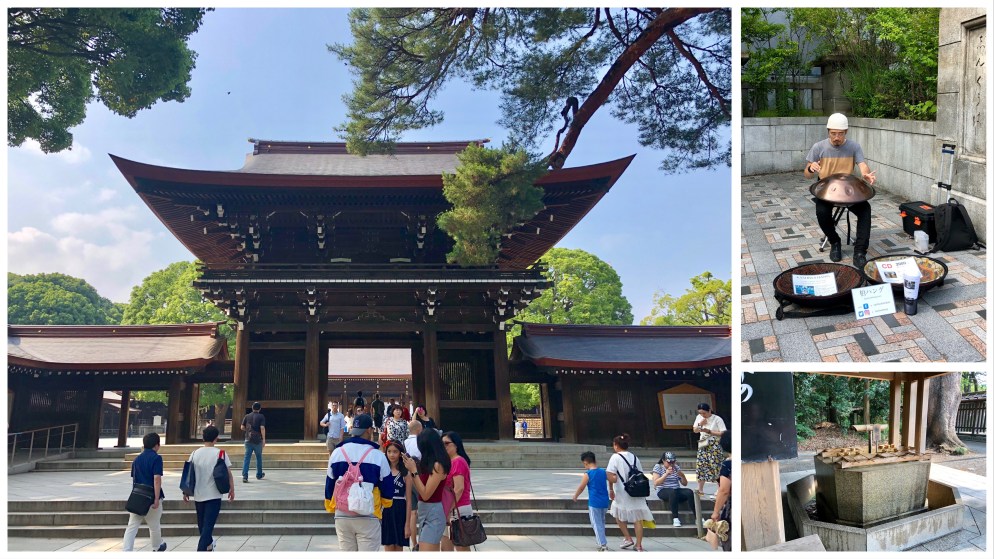
    There are some gorgeous, big green spaces in Tokyo, and Yoyogi Park is one of them. It’s home to a lot of cute, meticulously preserved attractions, but the main feature is Meiji Jingū (Meiji Shrine), a Shinto shrine which was finished in 1920 (rebuilt again after WWII) and dedicated to Emperor Meiji and Empress Shoken. As the name implies, Emperor Meiji was guy who presided over the Meiji Restoration which, to my limited historical understanding, put an end to the Tokugawa Shogunate and transitioned Japan from a feudal social/economic system to a modern market society.

    Meiji Jingū, a dude playing a Hang, and the water purification pavilion

    (Sorry that the pictures are included as collages. WordPress is such a struggle.)

    The bottom right image above is a chōzuya or temizuya, which means a little pavilion used for water purification at Shinto shrines (and sometimes Buddhist temples?). There’s this process in which you use ladles and the running water to cleanse your left hand, then right hand, then mouth, then left hand, then ladle (or some combination of these actions) before you enter the shrine. I tried to follow this while we were at Meiji Jingū, but I couldn’t quite figure out if the mouth step was supposed to involve actually drinking from the ladle or just awkwardly pouring water over your face, and I felt very much the gaijin trying to partake in something I don’t have a claim over. (I haven’t attempted it since.)

    Goshuin and Goshuin-Cho

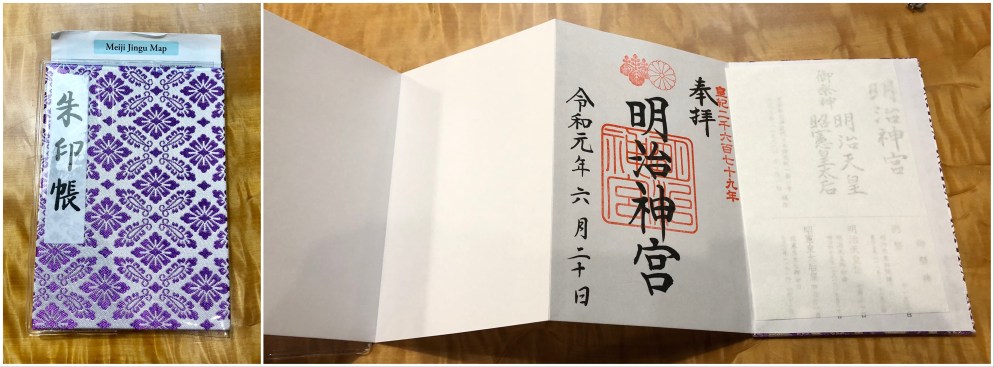
    Meiji Jingū was also the first opportunity for me and Jane to start collecting goshuin, which are artistic combinations of stamps and calligraphy that are unique to a shrine or temple. Goshuin are compiled in goshuin-cho, which are special accordion-style notebooks designed for the little art pieces. Only monks (?) of the temples or shrines can prepare goshuin, and they will not write them into other kinds of notebooks.

    Our first goshuin-cho and Meiji Jingū’s unique goshuin within

    Goshuin normally require another kind of offering (between ¥300 and ¥500), and feel a little commercialized at big shrines where goshuin-writing tables or windows attract long lines. (Later, we saw a woman at Toshogu Shrine drop off like fifteen goshuin-cho for the monks to deal with!) You can purchase the books at any shrine that offers goshuin, and the covers of the books sometimes relate to the shrine they came from. We ultimately decided to use a different goshuin-cho from this first one we received (gasp! Sacrilege!), but it was still quite special.

    Japanese Curry and Ichiran Ramen

    We also checked off two of our Japanese chain must-eats:

    • Curry House CoCo Ichibanya, which sells cheap and delicious Japanese curry with an assortment of meats, stocks, and spice levels. You eat at a long bar facing the chefs, like many restaurants in Japan. Delish.
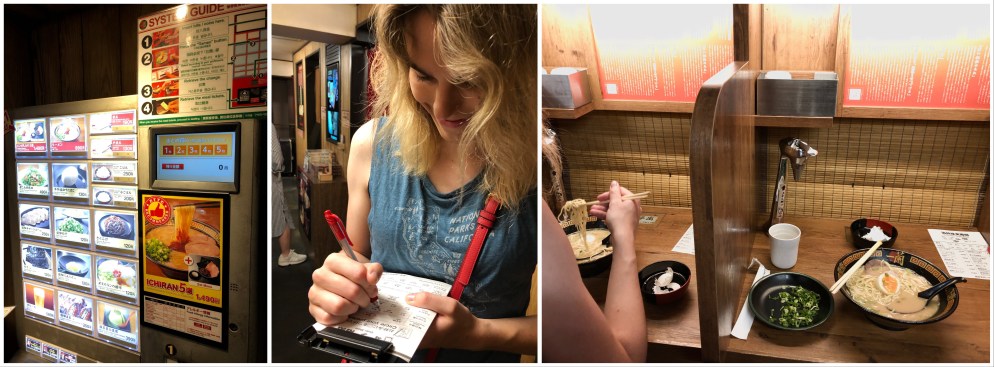
    • Ichiran Ramen, which is this whole thing that everyone talks about on Japan travel forums. It’s single-booth dining, supposedly designed for Japanese schoolgirls who didn’t want to interact with people while dining or allow anyone to see them eat. (Seems a little like treating the symptoms instead of the root of the issue, but maybe I just don’t understand Japanese culture.) You order from and pay at a vending machine which spits out a ticket, select a vacant booth from another machine, hand the ticket to a chef whose abdomen is visible through a small window at the back of the booth, and receive your ramen. We went to the Ichiran in Shinjuku, though, which was so popular that it involved lots of face-to-face contact with employees: managing the line out front; ushering patrons into either the basement or the 6th floor dining room based on availability; helping people select extras on a form in addition to the ticket; showing us to our seats. All of the direction kind of spoiled the I’m-shy-and-don’t-want-to-see-anyone feel, but the ramen was still pretty good!
    Vending, ordering (shouldn’t this have been part of the vending step??), and eating at Ichiran Ramen

    More Shibuya

    Turns out that the crossing outside Shibuya Station (and near Hachikō) is actually really famous for its wide crosswalks and heavy foot traffic. We almost didn’t notice because it feels like every intersection is like that! There’s a strong commuter culture here and most businesspeople take trains to work when possible. Every major crossing is a flurry of white shirts and black business pants. Shibuya Crossing in particular also has a high level of tourist traffic.

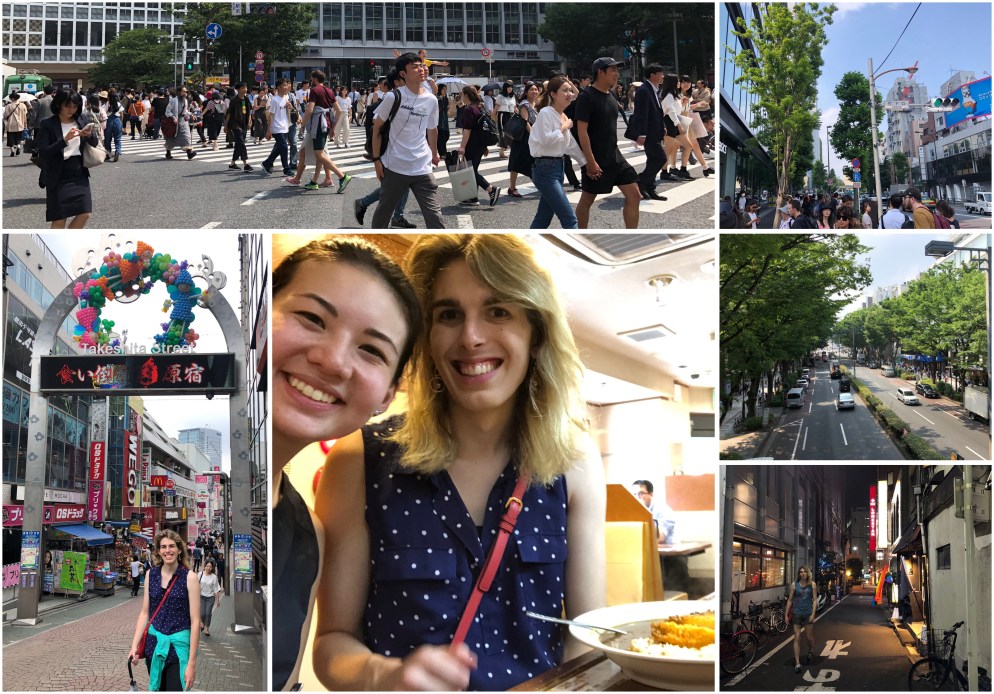
    Clockwise from UL: Shibuya Crossing; two views of tree-lined Shibuya; Shinjuku streets at night; me and Jane having Japanese curry at CoCo Ichi; Jane at the entrance to Takeshita Street

    Hong Kong: Dim Sum for the Road

    Tuesday, June 18

    Honestly, I’d love to spend some time in Hong Kong, but it wasn’t really on our radar for this trip. We’re leery of China for obvious reasons and even though Hong Kong is trying to keep itself somewhat separate (as evidenced by the recent protests), it’s still pretty out of the way for us. BUT tickets to Japan are expensive, and at the time we were looking, there was this crazy deal that would get us to Tokyo via Hong Kong for $450 a person. The hours were funky and there was no way for us to get the deal by booking directly through Hong Kong Air, so we took a chance and booked through Kayak via this third party service called Vayama. I managed to finagle a longer layover (8 hours) instead of the funky 5 hours or so we were initially offered.

    Every travel advice column ever advises against using these third-party services. Vayama gets abysmal reviews. So does Hong Kong Airlines, incidentally: they both seem to have a high rate of randomly cancelling or delaying trips. I learned immediately that Vayama sends you a copy of your ticket information but locks you out of the airline’s system (e.g., I couldn’t attach the trip to my new Fortune Wings Club Hong Kong Air account), and as I discovered more recently after our seats reverted to random middle seats instead of the aisle seats that I spent half an hour on the Hong Kong Air help line securing, Vayama reserves the right to randomly change aspects of your reservation without notice.

    Did I mention the first leg was 14.5 hours long? High potential for disaster.

    Any yet, it all went perfectly. Online check-in (through Hong Kong Air’s absolutely horrendous site) allowed us to re-select seats independent from Vayama, my carry-on was allowed onto the plane with a smile despite being weighed at 8.1 kg instead of the required 7, and the actual aircraft was massive, new, and well-equipped. We even enjoyed the two airplane meals (although we hadn’t packed enough water to last us the entire flight and felt like grass in a desert by the end of it). Honestly, I can’t recommend Hong Kong Air enough.

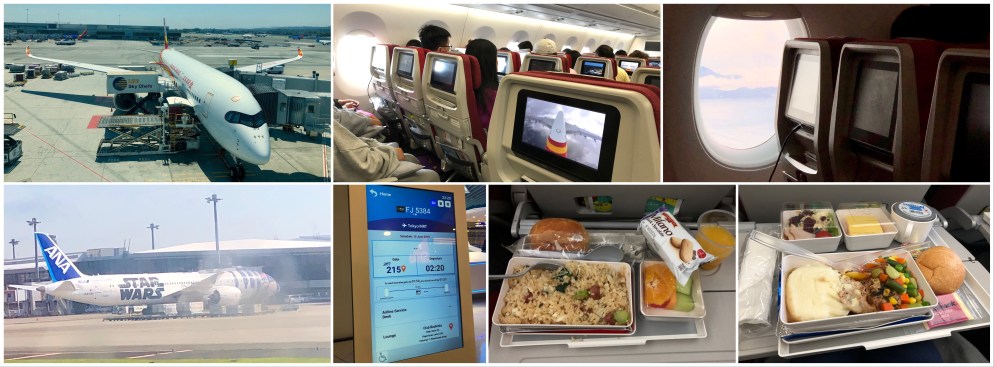
    Top row: our first Hong Kong Air plane, the view from inside the plane with the tail camera on the screen, our first window view of Hong Kong. Bottom row: an R2D2 plane, these awesome kiosks in Hong Kong International Airport that will calculate the time to walk to your gate, and two meals (Chinese sausage fried rice and grilled chicken).

    Our plan for Hong Kong started as this: a quick jaunt up to Victoria Peak, where we would watch the Symphony of Lights, the nightly lightshow over Hong Kong’s skyline. Then, we’d pop down into the city for some good food, walk along the harbor a little, and take the train back. Our backup plan was to see the lightshow from the Star Ferry in Victoria Harbour.

    We hadn’t really done any research for this because it felt very low-priority compared to the longer legs. If we had, we would have known that:

    1. You can’t really see the Symphony of Lights from Victoria Peak, although the view is still lovely.
    2. The Symphony of Lights happens at 8pm, and we probably wouldn’t be able to disembark, navigate immigration and customs, and take transit anywhere to see it in time.

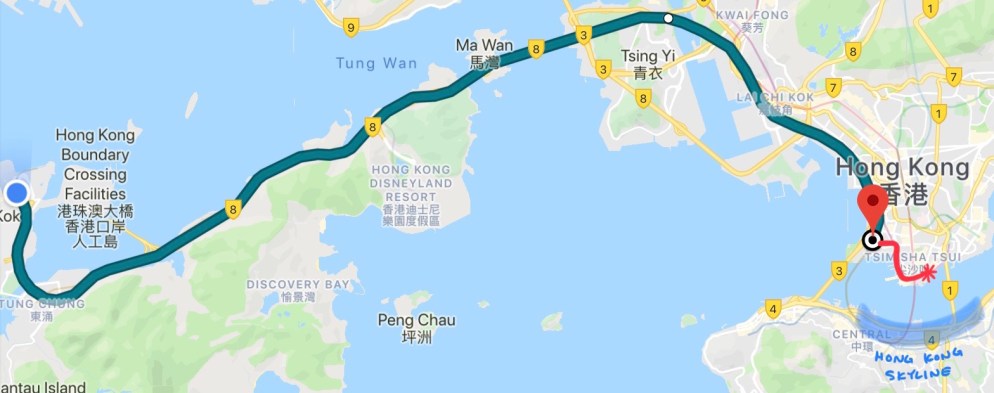
    Luckily, we were nervous enough about missing our connecting flight at 2:20 AM that we almost didn’t leave the airport at all. Instead, we compromised with a plan to take the Airport Express to the north half of Hong Kong, where we would check out the view of the city from the 100th-floor observation deck in Sky100, and then grab some food in Tsim Sha Tsui before heading back.

    Okay well I guess the most commonly seen skyline is the one we were a part of, not the one across the river, but still

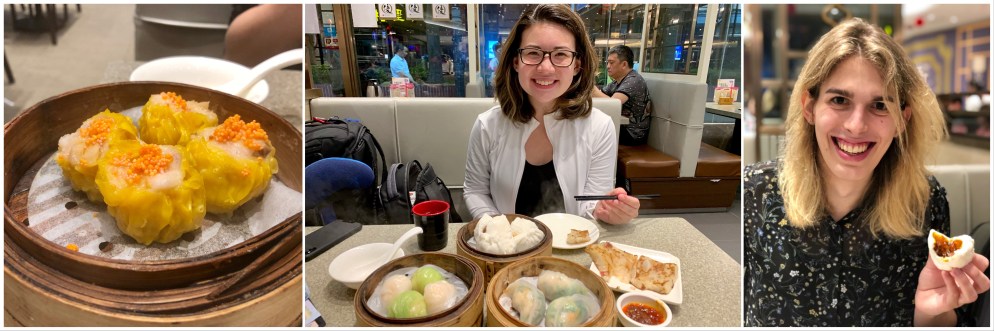
    Even the most half-assed plans oft go awry. We exchanged currency at the airport and bought round-trip same-day Airport Express tickets (105 HKD = 13.44 USD) for Kowloon Station. Turns out that Sky100 closes early on weekdays. In the empty lobby, we ran into a Taiwanese woman and her son (both from San Jose) who had gotten off the same flight with the same plan as us and shared a taxi with them down to Tsim Sha Tsui. Their connection was the next morning at 10 AM. We split up once we arrived in Tsim Sha Tsui, which seems to be known for having lots of food (again, I didn’t really do research on Hong Kong). I had no idea that late-night Dim Sum was a thing, and now I never want to go back! We found a decent-looking place and I was able to use my limited Mandarin to specify the size of our group (fun but not really necessary since counting fingers is a universal language and potentially kind of out of place because Hong Kong uses Cantonese?). The lo bak go (turnip cake) was pretty standard, but the siu mai were amaaaaazing—so fresh and delicate! And the cha siu bao (steamed BBQ pork buns) were out of this world. We would have ordered additional servings had we not already been so full.

    Late-night Dim Sum.

    We made it back to the airport with tons of time to spare, and we realized (in the two remaining hours we had to sit) that if we’d stayed in the airport over the course of the layover, we would have been bored out of our minds and also asleep. We were worried that public transit would be busy because of the massive protests a few days before, but there hadn’t been any more mass events since Carrie Lam’s apology on Sunday; and they probably wouldn’t have affected us at that hour anyway. The only reference to the millions of people marching to keep China’s long legal arm out of Hong Kong was a friendly airport agent’s joke: “You bringing anything back? Tear gas? Rubber bullets? Nah? Okay, come on through.”

    We slept all the way through the next leg (4.5 hours to Japan). Once again, no complaints about Hong Kong Air. When we woke up, we were in Japan!

    San Francisco: Plunging Headfirst into Housing

    Wednesday, June 12 – Monday, June 17

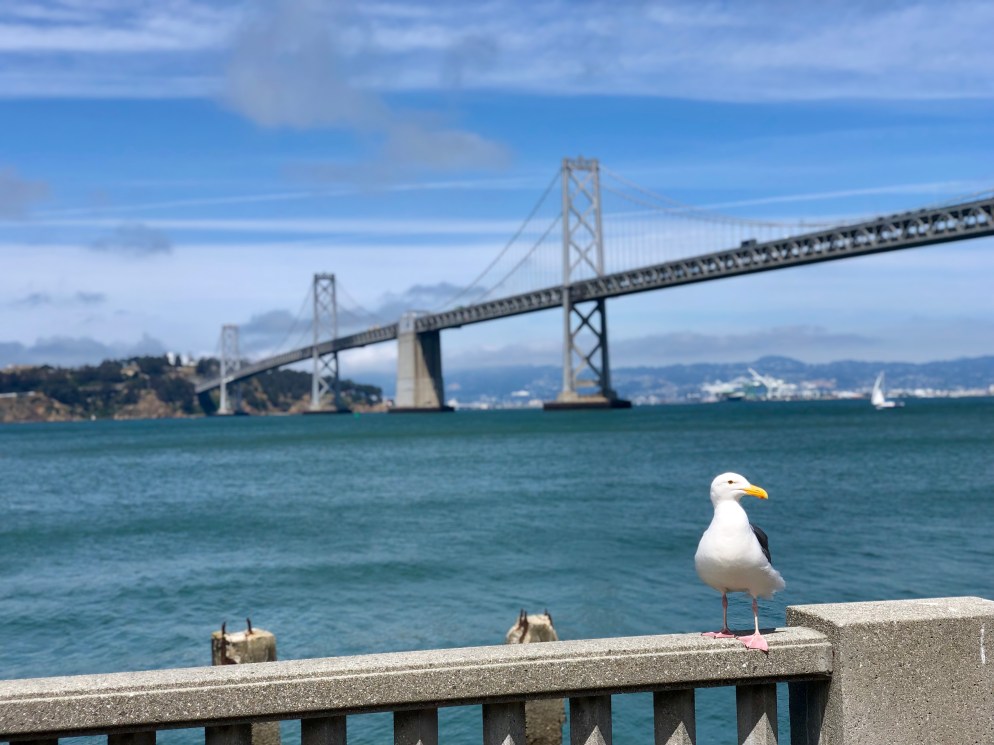
    Caw!
    There’s always time for sightseeing! Our hosts took me down to the waterfront while Jane stopped by her SoMa office

    Was shopping for an apartment in San Francisco exhausting in spite of the fact that we only spent three days doing it, or was it exhausting because we crammed all of our tours into three days?

    In retrospect, it’s a little crazy that Jane and I decided to spend a week in San Francisco looking at apartments in the middle of June, given that we wouldn’t be able to move in until two months later (after looking at historic month-by-month rent trends for listings we did not want to leave it off until August). We booked a flight into San Jose on Tuesday the 11th and bookended it with the beginning to our round-the-world trip the next Monday, which meant that we had five full days of touring available in which to navigate the San Francisco housing market. If we weren’t already nervous coming in, we definitely were after one of the first landlords we talked to described the process as “the hunger games.”

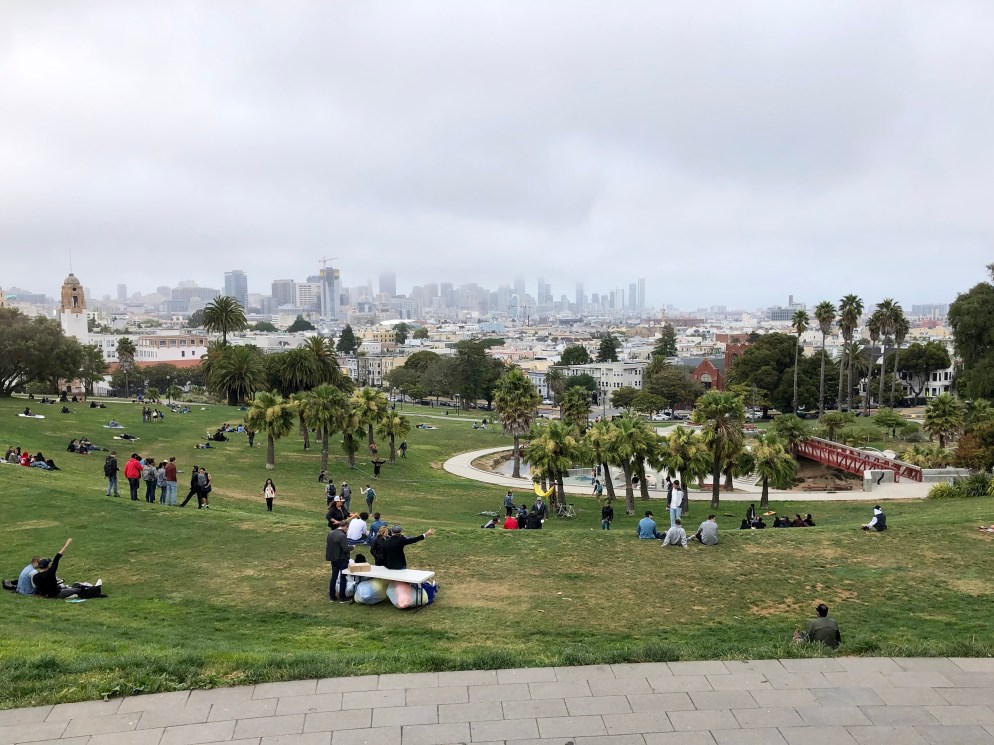
    I won’t get into the actual hunting process, but here’s the gist: many, many listings, a 50% response rate, and, after a ton of paperwork, approval from our top three apartments. Choosing between them took a three-hour discussion in which we walked between each of the neighborhoods in turn, looping back and back again to Mission Dolores Park. In the end, we signed a lease for an incredible apartment. We joked that we wanted to move in right away instead of going on our big trip… at least, I think we were joking.

    View from the southwest corner of Mission Dolores Park

    One of the highlights of this trip (besides the hospitality of our friends in San Jose and landing an apartment and some peace of mind) was being able to spend almost three non-stop days in the Mission. Some highlights:

    • Dolores Park Cafe (on the northeast corner of the park) is probably hideously overpriced but we still went there every time we were in the area and needed a bathroom or a place to work on application paperwork: it’s spacious, clean, and charming, and has a great view of that side of the park. Good cappuccinos and something called a Chai Crusher (?) which involves coconut milk, banana, and honey.
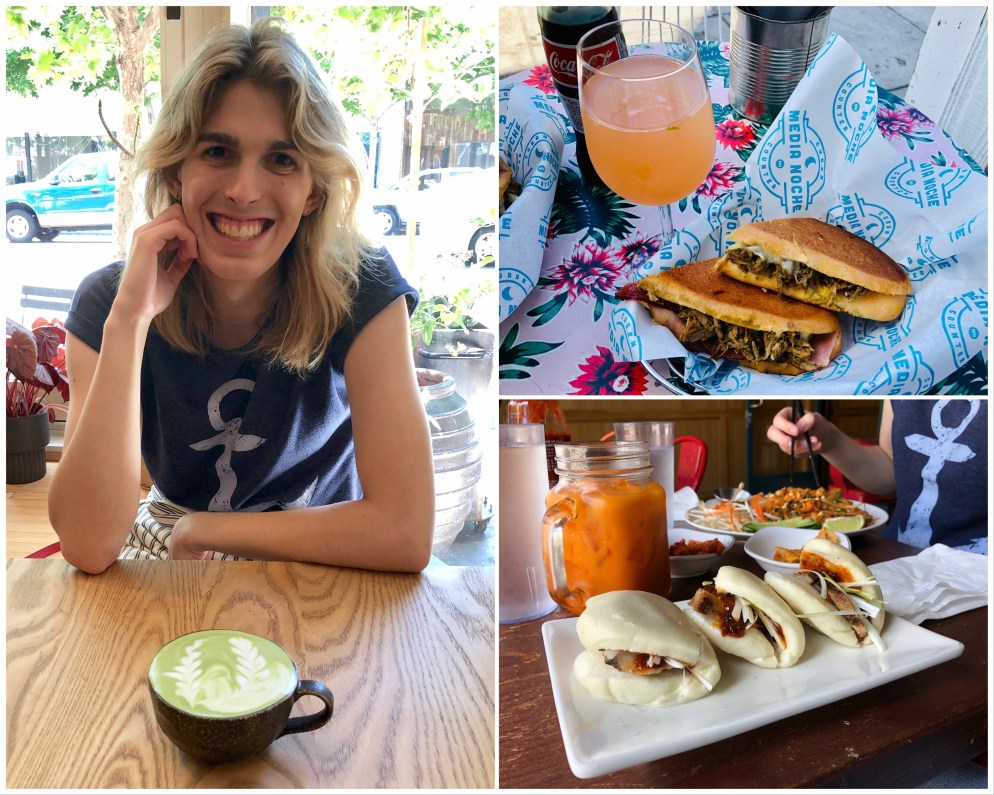
    • Slurp Noodle Bar has delicious miscellaneous Asian noodles and the sweetest (probably gay) waiter who called us “sweeties” and “dears” (and “ladies,” which we don’t always get as a couple) after we toured an apartment on Castro Street. It felt very much like a “welcome to the Castro” experience and made us sad that we were mostly looking at places further east; although it seems like the Mission is a pretty queer neighborhood too. I’ve never felt so welcome in a restaurant.
    • Tacquería El Farolito—I guess there’s a reason this has 4.5 stars with 2,794 reviews on Google Maps. I didn’t realize until now; when we were there, it felt a bit like a hole-in-the-wall discovery, but this explains the massive crowds (which were mostly Hispanic, like that part of lower Mission). Maybe I should have been tipped off to its popularity when a Mariachi band started playing.
    • Stonemill Matcha had a lovely ginger matcha latte (can’t speak for the many other matcha-themed snacks and drinks but they certainly looked good) and was a nice spot to get off the street for a bit.
    • Media Noche specializes in delicious delicious cubanos but is definitely not a “hidden gem” kind of place; it looked too spacious and pristine to be any kind of authentic, but then again, California is pretty far from Cuba. We arrived just as happy hour began and I had a guava sangria to celebrate getting approval for our top two apartments. Cubans make any tough decision easier.
    • Yucca fries and ali de gallina, argentine beef, and mushroom empanadas at Destino, a Pisco bar near the apartment we eventually decided upon (we’ll have plenty of time to sample their Piscos in the future)!
    • Manny’s, a hybrid coffee shop/bar/event space/political coffee shop near the 16th St. Mission BART station, provided a much-needed bathroom towards the end of one day, but we would have loved to spend more time there. Also, we saw flyers announcing that Cory Booker would be there on Sunday—it’s not a large place, and it’s going to be mobbed!
    • This guy (I hate to profile but he was also probably gay, which is a plus for us because it speaks to the queerness/acceptance of the neighborhood) on Cumberland street who saw us ogling his dogs from across the street and beckoned us over to introduce us to his whippet (sooo friendly) and greyhound (tall and shy).
    • Gorgeous murals all over the Mission.
    • DOGS!!! Oh my god, so many dogs. We probably passed by 100 dogs per day (we spent quite a bit of time in the city, to be fair), without exaggeration. Heaven.
    Clockwise: Jane with a ginger matcha latte, “El Cubano” from Media Noche, and delicious bao from Slurp Noodle Bar

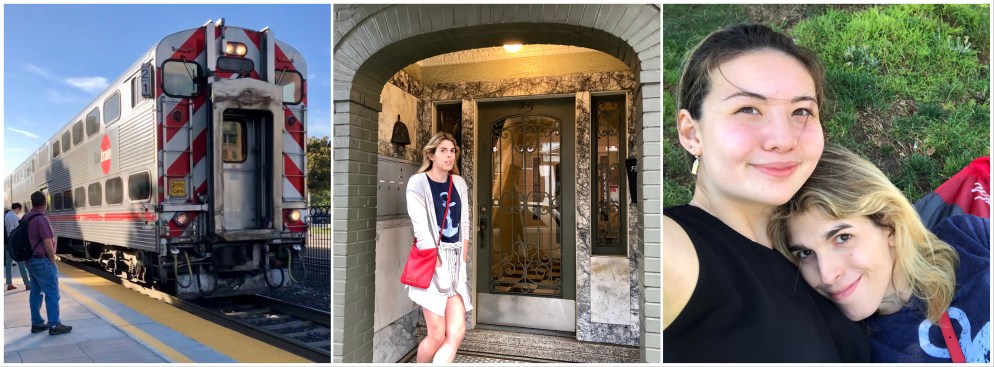
    In addition to getting more familiar with the Castro, the Mission, and Lower Haight, I also learned how to take Caltrain, BART, and Muni (which, I was frequently reminded, I should not pronounce “moony”). We took Caltrain in and out of the city (an hour and a half commute!) two out of the three days, and benefitted from the generosity of our car-owning hosts on the third, which gave us a chance to see the gorgeous fog banks rolling into the peninsula.

    Caltrain at Sunnyvale Station, Jane freezing in the fog outside an apartment, and a quick break in Mission Dolores Park

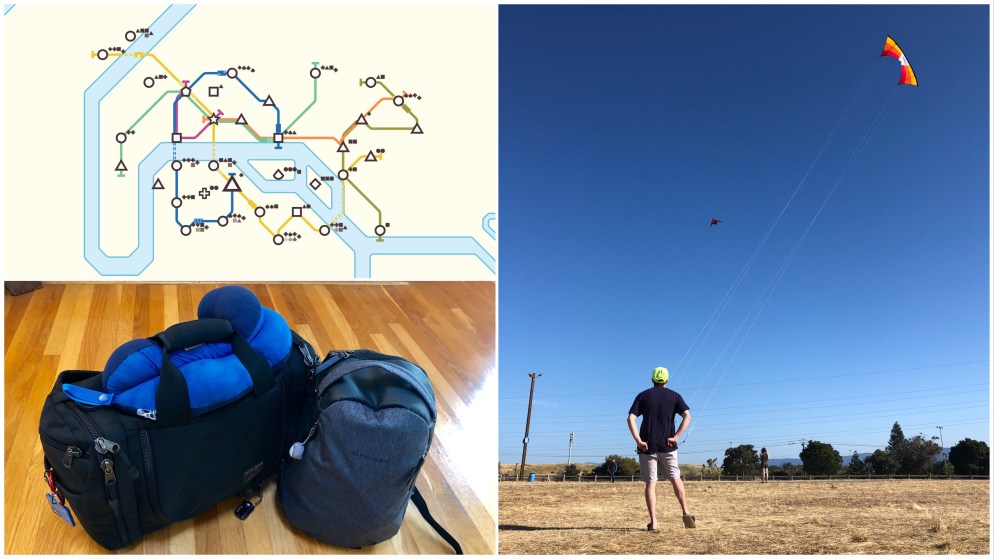
    Also worth a mention: we became obsessed with this mobile game called Mini Metro in which you get maps of different cities and have to build metro systems as demand grows. I haven’t played an iPhone game in ages, but this thing is simple and elegant and satisfying and hard! Also: we went kite-flying on Sunday and it’s getting me pumped for Bay Area wind. And finally: we’re both traveling with carry-ons only, which took a bit of packing! Jane is truly one-bagging it; I have a backpack (Tom Bihn) and a smaller backpack (Sherpani) as my hand luggage.

    Are all iPhone games this well-designed these days? I think I’ve been missing out since I built a PC

    See you again soon, San Francisco!